https://twitter.com/FareedZakaria/status/1792259556766105698
Monday, May 20, 2024
Wednesday, March 27, 2024
Labour segmentation in NCR Delhi’s automobile sector: a political response of capital to labour struggles | Shreya Ghosh & Ritajyoti Bandyopadhyay
The Third World Quarterly
Received 06 Jul 2023, Accepted 04 Mar 2024, Published online: 23 Mar 2024
https://doi.org/10.1080/01436597.2024.2327457
Taylor & Francis Online
Abstract
This paper aims to understand the changing dynamics of internal labour market segmentation intertwined with the history of working-class struggle in an industrial belt in India’s National Capital Region (NCR). Nuances of workers’ class struggle in the automobile sector in Delhi-NCR over the last 15 years have shown that unity between permanent and contract workers was key to several successful struggles against worsening work conditions and management control within the global value chains of automobile production. Our fieldwork findings, along with direct and indirect political engagement in the region, reveal that increasing salaries and allotment of supervisory roles to small sections of permanent workers, coupled with the simultaneous fragmentation a lower strata of workers into multiple categories with very low salaries, benefits and heavy workloads, have been significant attempts by capital to break class solidarity among different sections of workers. Relatively pro-labour legislation and trade unions tend to concentrate in high-wage zones, while low-wage and precarious employment remains unprotected by such institutional mechanisms. Labour segmentation is inherent to capitalist exploitation, guarded by institutional mechanisms. Advanced mechanisation reduces distinction of skill requirements between highly paid permanent and lowly paid contract workers. In this context, labour segmentation is a political response to trade unionism from the side of capitalist management.

Monday, March 18, 2024
Friday, March 8, 2024
Tuesday, March 5, 2024
‘India-B’desh FTA threat to local textile industry’
‘India-B’desh FTA threat to local textile industry’
Paper on Gender Division of Work and Wages in Rural India
GENDER DIVISION OF WORK AND WAGES IN
RURAL INDIA
https://fas.org.in/wp-content/uploads/2024/03/Work-Package_1_paper-on-wages.pdf
Monday, March 4, 2024
Thursday, February 29, 2024
Video: "The Sterlite Plant in Tuticorin Must be Dismantled" | NewsClick, (2018)
Paranjoy Guha Thakurta talks to M G Devasahayam about the killings at the Tuticorin Sterlite plant
Friday, February 23, 2024
Saturday, February 10, 2024
India: Ten-Year Record on Employment: Does the Reality Match the Promises or Claims? | Santosh Mehrotra
The Wire
Ten-Year Record on Employment: Does the Reality Match the Promises or Claims?
GOI efforts to spin a jobs growth narrative has meant the following: it is not willing to recognise a glaring problem, and hence no concrete efforts are needed to change economic policy to make the growth pattern more labour-intensive.
07/Jan/2024
by Santosh Mehrotra
This article is part of The Wire‘s ‘India Black Boxed’ series. Read it here: Introduction | Part I
The current regime started with pretty impressive promises in 2014 with respect to employment (two core jobs a year). If realised, by March 2024, 40 crore new jobs should have materialised. Have they? If not, what is the reality?
The reversal of employment growth in non-farm sector and little progress in Skill India
The reality is the following. First, open unemployment was barely 2.1% in 2012 (the last year for which data was available before the BJP came to power). It had already nearly tripled to 6.1% in 2018 (National Survey Organization’s Periodic Labour Force Survey (PLFS), conducted annually since 2017-18), the highest rate in 45 years of India’s labour force surveys.
The total number of unemployed was one crore (2012) before the BJP came to power – but it had tripled by 2018 to three crore. The youth unemployment rates went through the roof for: those with middle school (class 8) education it rose from 4.5% to 13.7%; with secondary education (class 10) from 5.9% to 14.4%; those with higher secondary (class 12) education from 10.8% to 23.8%.
Educated unemployment worsened sharply. For graduates, the unemployment rate rose from 19.2% to 35.8%; and for post graduates from 21.3% 36.2%. All this did not deter the Government of India (GOI) from announcing a New Education Policy 2020 that higher education enrolment should rise from the prevailing 27% (for the relevant age cohort of 18-23 year olds) to nearly double to 50% by 2035. How are these new higher education graduates supposed to be employed, if the current crop of graduates face rising unemployment.
ls Report 2021 argues that nearly half of India’s graduates are unemployable, i.e. education quality in our colleges/universities has deteriorated sharply, most noticeably after the massification of higher education in the last two decades. Two developments underlie this phenomenon. First, the number of affiliated colleges (attached to universities, where the exam is conducted by the state or central university) has grown in India from around 10 000 in the early 2000s to 42 000 to 2020. The Universities (let alone the University Grants Commission) have limited capacity to regulate or monitor the activities of such colleges; yet they have grown at a rate of 4 new colleges per day, without a weekend break. Two, most of these colleges are private, set up by builders and contractors, in connivance with local politicians, who are often elected to high offices. If this pattern of private college growth, the quality is unlikely to improve, so unemployment may remain much the same – if non-farm jobs do not grow fast enough to absorb new entrants.
[ . . . ]
Wednesday, January 17, 2024
Wednesday, January 10, 2024
Reproducing Dispossession and Erasure within a Waste Picker Organization in Mumbai | Sneha Sharma
IJURR Vol 47. Number 5 September 2023
GEOGRAPHIES OF EXCLUSION:
Reproducing Dispossession and Erasure within a Waste Picker Organization in Mumbai
by Sneha Sharma
Abstract
A rich seam of waste scholarship already addresses the exclusion faced by informal waste workers as cities in the global South undergo spatial transformations to become ‘world class’. However, less attention has been paid to how state practices have reproduced inequalities within and across waste picker communities. Drawing upon eleven months of ethnographic research at Mumbai’s Deonar dump site, this article maps the practices through which waste workers have responded to their exclusion following a massive fire in 2016. It demonstrates that social exclusion is experienced differently by different members of the community and calls for a greater focus on heterogeneity amongst waste workers. Multi-dimensional vulnerabilities manifest through these workers’ deal-making strategies, while simultaneously mirroring the conditions of marginality produced by the state. The article contributes to debates on marginality by employing the lens of erasure to show how exclusion relies on the optics of visibility and invisibility. By unpicking the hierarchical structure within one waste worker organization, the article argues that the state-led mandate for garbage-free cities in India disproportionately affects those located at the margins of marginalized groups.
DOI: 10.1111/1468-2427.13204
Saturday, January 6, 2024
Tuesday, January 2, 2024

Wednesday, December 27, 2023
Sunday, November 26, 2023
India: The hypocrisy of our concern for workers trapped in Uttarkashi tunnel ¬ Sanjay Srivastava
The hypocrisy of our concern for workers trapped in Uttarkashi tunnel | Sanjay Srivastava
The migrant labour force produces the visible signs of national pride — governments proudly proclaim the making of a new and global India — but itself becomes invisibilised
Written by Sanjay Srivastava
Updated: November 25, 2023
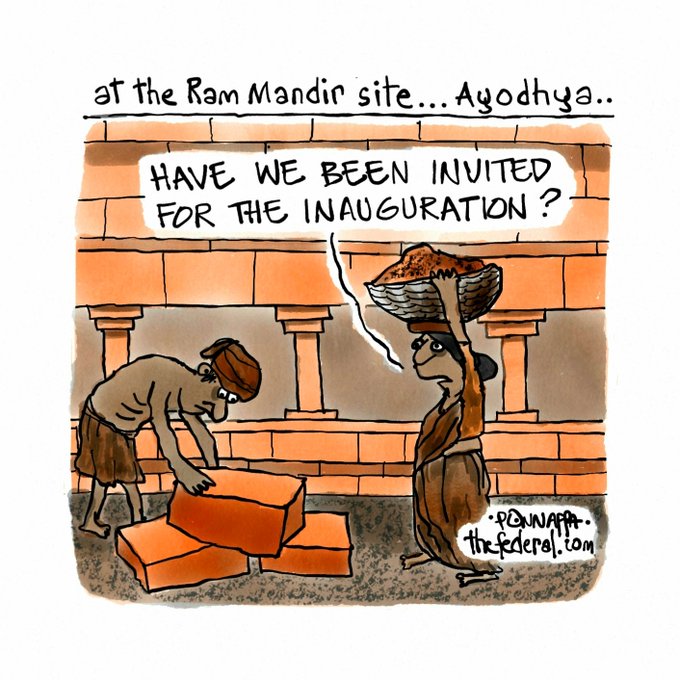
We build statues, name stadiums and write hagiographies to honour Bollywood stars, cricketers, politicians and a pantheon of celebrities. But for the human infrastructure of the nation — the women and men who build tunnels and highways, run factories, service middle-class homes — there are only obituaries of anonymity. The hapless migrant worker is truly the forgotten citizen, mainly breaking the surface of national consciousness as a figure in televised tragedy. “National greatness” is attributed to the products of migrant exertion — shiny new expressways and gigantic statues — but is never expressed in the vocabulary of care and policy requirements for those who make the nation great.
Flung from the abjection of village life into the hostility of their new, distant environments, migrant workers largely exist in the national consciousness as dispensable life. They are driven out of cities during periods of health crises,
Wednesday, November 15, 2023
Bangladesh garment workers fighting for pay face brutal violence and threats | Thaslima Begum and Redwan Ahmedin (Nov 15, 2023)
The Guardian
Bangladesh garment workers fighting for pay face brutal violence and threats
Workers describe hands and arms being targeted in ‘merciless’ beatings as protests over low wages turn increasingly violent in Dhaka
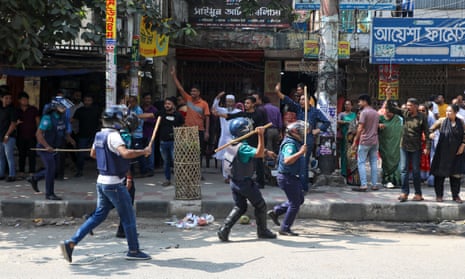
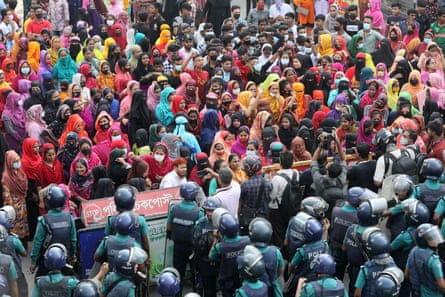
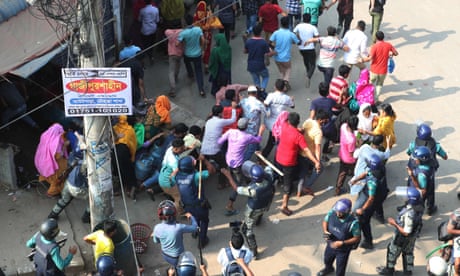
Garment workers clash with police in Dhaka on 2 November during protests over low wages in Bangladesh. Photograph: Kazi Salahuddin Razu/NurPhoto/Shutterstock
When Masuma Akhtar arrived at the garment factory where she works on the outskirts of Dhaka on 31 October, she was expecting a normal shift. Instead, she was met with brute violence. “The moment I walked through the factory gates, a group of armed men began beating me with wooden sticks,” says Akhtar. “I fell down on to the ground. Even then they wouldn’t stop beating me.”
Akhtar, 22, is a seamstress at Dekko Knitwears in Mirpur, where she spends long days churning out clothes for western fashion brands, including Marks & Spencer, C&A and PVH Corp, which owns Tommy Hilfiger and Calvin Klein.
Bangladesh is one of the world’s biggest producers of fast fashion, pumping out millions of tonnes of clothing every year to meet the demands of the world’s most popular clothing brands, which are drawn to this small South Asian country where orders – and the labour needed to fulfil them – come cheap.
Although most fast fashion brands that source from Bangladesh claim to support a living wage, they are only required to pay the workers who make their clothes the legal monthly minimum wage, which is one of the lowest in the world and has remained set at 8,000 taka (££58) since 2018.
Negotiations over a new minimum wage for garment workers in Bangladesh have sparked mass demonstrations on streets across the capital. The protests have escalated since the government announced a minimum wage increase for the workers, from 1 December, to 12,500 taka (£90), far below the 23,000 taka a month workers say they need to keep their families from starvation.
Factory owners and police have responded to workers’ protests with threats and violence. The beatings she received by armed men at Dekko Knitwears left Akhtar with a broken arm. “They hit my back, my thighs and my arms repeatedly,” she says. Now, without use of one of her arms, she is unable to work. “I don’t know how I will survive the rest of the month,” she adds.
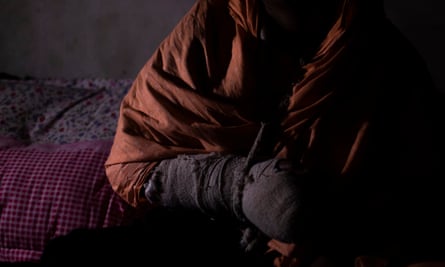
Other workers at Dekko Knitwears say that the men beating them concentrated on their hands and arms. “They started hitting us mercilessly,” says Bushra Begum, 25, another worker. “My livelihood depends on my hands, and they targeted them viciously.”
Her colleague Rita Anwar, 26, tried to run away but was chased down the road by three men. “I am covered in blood clots,” she says, pulling up her sleeve to reveal her injuries. “My back is black with bruises. The pain is so much that I can barely walk.”
Before they left, the men issued a warning: the workers were not to take part in any more protests – or they would face consequences.
As protests in Dhaka turned increasingly violent, two garment workers have been killed, allegedly after being shot by police in the first wave of protests. And last Wednesday, another woman died after being shot in the head.
Factory owners also threatened to shut down production and withhold wages by applying a “no work, no pay” rule. Over the weekend, more than 150 factories closed “indefinitely”, as police issued blanket charges for 18,000 workers in connection with the demonstrations.
Workers were warned of dismissal if they continued to protest and the Bangladesh Garment Manufacturers and Exporters Association, a trade body, called for all factory recruitment to be paused, making it difficult for protesters to find work elsewhere.
But despite the violent crackdown on workers, those who have spoken to the Guardian are determined to see the fight through to the end.
“They are trying to silence us but we won’t back down,” says Naima Islam, a machine operator at Columbia Garments. “They can threaten and beat us but what they don’t understand is, we have nothing to lose. If we accept their ridiculous wage proposal, we will starve to death anyway.”
Islam, 28, is one of thousands of protesters who have had police reports filed against them, which trade unionists fear may soon lead to mass arrests. Many believe it is an attempt to forcefully suppress the wage increase movement.
But that hasn’t deterred Islam and her co-workers. “We are not asking for much. This entire industry is built off our backs – the least we deserve is the bare minimum to survive,” she says.
Nazma Akter, president of local trade union Sommilito Garments Sramik Federation, condemns the violence against protesting workers. “The Bangladesh government must ensure workers are able to exercise their rights to freedom of association and collective bargaining without fear of violence, reprisal, or intimidation,” she says.
In a statement, Marks & Spencer said: “These are very serious allegations and we are urgently investigating them. We would never tolerate violence or intimidation of workers and set out very clearly in our global sourcing principles that workers must be guaranteed freedom of association and a safe workplace, as well as fair and transparent wages. As a member of the Ethical Trading Initiative, we have supported the tripartite minimum wage negotiations between the unions, Government Wages Board and the Employers’ Association – and we continue to support cross-sector calls for an increase that provides a decent standard of living for workers.”
A spokesperson for C&A said: “We are aware of the incident that took place in Bangladesh, and we are in close contact with the supplier to investigate. We condemn all types of violence, and we have a longstanding commitment to ensure the safety and health of all workers in our supply chain.”
PVH did not respond to a request for comment.
Dekko Knitwears and Columbia Garments were approached for comment but did not respond.
Fashion brands sourcing from Bangladesh have said they support workers’ calls for a higher minimum wage. In a joint letter in September, brands including Asos, Primark and H&M, wrote that they recognised their role in “supporting wage developments”. But rights groups argue that this means little if brands don’t agree to pay their suppliers more.
Yesterday, Human Rights Watch and Clean Clothes Campaign called on brands to take responsibility for their workers’ wages and pay their suppliers more. Aruna Kashyap, associate director on corporate accountability at Human Rights Watch says: “Wage increases have consequences for suppliers’ costs and eat into their profit margins.”
“Brands themselves are driving low wages with their unfair pricing and purchasing practices,” she adds. “To preserve their own profits, brands are putting themselves first.”
Monday, October 2, 2023

Subscribe to:
Posts (Atom)