Showing posts with label wages. Show all posts
Showing posts with label wages. Show all posts
Monday, March 18, 2024
Tuesday, March 5, 2024
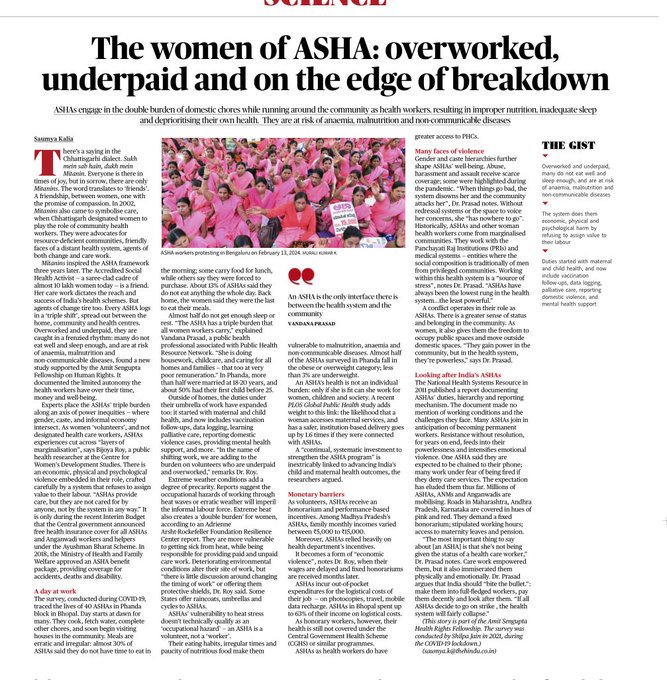
Paper on Gender Division of Work and Wages in Rural India
GENDER DIVISION OF WORK AND WAGES IN
RURAL INDIA
https://fas.org.in/wp-content/uploads/2024/03/Work-Package_1_paper-on-wages.pdf

Friday, February 23, 2024
Wednesday, November 15, 2023
Bangladesh garment workers fighting for pay face brutal violence and threats | Thaslima Begum and Redwan Ahmedin (Nov 15, 2023)
The Guardian
Bangladesh garment workers fighting for pay face brutal violence and threats
Workers describe hands and arms being targeted in ‘merciless’ beatings as protests over low wages turn increasingly violent in Dhaka
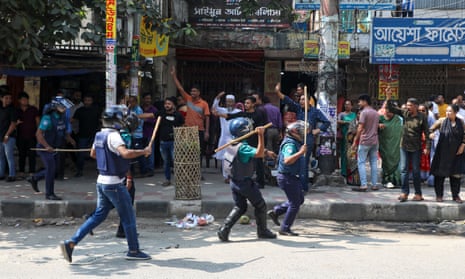
Garment workers clash with police in Dhaka on 2 November during protests over low wages in Bangladesh. Photograph: Kazi Salahuddin Razu/NurPhoto/Shutterstock
When Masuma Akhtar arrived at the garment factory where she works on the outskirts of Dhaka on 31 October, she was expecting a normal shift. Instead, she was met with brute violence. “The moment I walked through the factory gates, a group of armed men began beating me with wooden sticks,” says Akhtar. “I fell down on to the ground. Even then they wouldn’t stop beating me.”
Akhtar, 22, is a seamstress at Dekko Knitwears in Mirpur, where she spends long days churning out clothes for western fashion brands, including Marks & Spencer, C&A and PVH Corp, which owns Tommy Hilfiger and Calvin Klein.
Bangladesh is one of the world’s biggest producers of fast fashion, pumping out millions of tonnes of clothing every year to meet the demands of the world’s most popular clothing brands, which are drawn to this small South Asian country where orders – and the labour needed to fulfil them – come cheap.
Although most fast fashion brands that source from Bangladesh claim to support a living wage, they are only required to pay the workers who make their clothes the legal monthly minimum wage, which is one of the lowest in the world and has remained set at 8,000 taka (££58) since 2018.
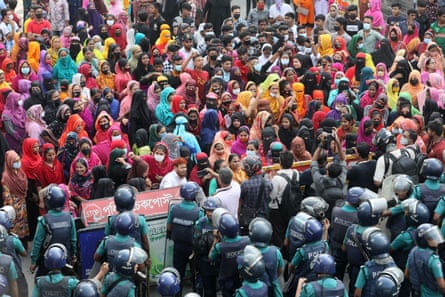
Negotiations over a new minimum wage for garment workers in Bangladesh have sparked mass demonstrations on streets across the capital. The protests have escalated since the government announced a minimum wage increase for the workers, from 1 December, to 12,500 taka (£90), far below the 23,000 taka a month workers say they need to keep their families from starvation.
Factory owners and police have responded to workers’ protests with threats and violence. The beatings she received by armed men at Dekko Knitwears left Akhtar with a broken arm. “They hit my back, my thighs and my arms repeatedly,” she says. Now, without use of one of her arms, she is unable to work. “I don’t know how I will survive the rest of the month,” she adds.

Other workers at Dekko Knitwears say that the men beating them concentrated on their hands and arms. “They started hitting us mercilessly,” says Bushra Begum, 25, another worker. “My livelihood depends on my hands, and they targeted them viciously.”
Her colleague Rita Anwar, 26, tried to run away but was chased down the road by three men. “I am covered in blood clots,” she says, pulling up her sleeve to reveal her injuries. “My back is black with bruises. The pain is so much that I can barely walk.”
Before they left, the men issued a warning: the workers were not to take part in any more protests – or they would face consequences.
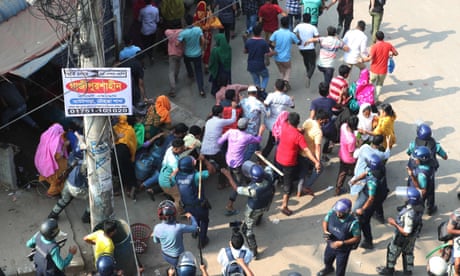
As protests in Dhaka turned increasingly violent, two garment workers have been killed, allegedly after being shot by police in the first wave of protests. And last Wednesday, another woman died after being shot in the head.
Factory owners also threatened to shut down production and withhold wages by applying a “no work, no pay” rule. Over the weekend, more than 150 factories closed “indefinitely”, as police issued blanket charges for 18,000 workers in connection with the demonstrations.
Workers were warned of dismissal if they continued to protest and the Bangladesh Garment Manufacturers and Exporters Association, a trade body, called for all factory recruitment to be paused, making it difficult for protesters to find work elsewhere.
But despite the violent crackdown on workers, those who have spoken to the Guardian are determined to see the fight through to the end.
“They are trying to silence us but we won’t back down,” says Naima Islam, a machine operator at Columbia Garments. “They can threaten and beat us but what they don’t understand is, we have nothing to lose. If we accept their ridiculous wage proposal, we will starve to death anyway.”
Islam, 28, is one of thousands of protesters who have had police reports filed against them, which trade unionists fear may soon lead to mass arrests. Many believe it is an attempt to forcefully suppress the wage increase movement.
But that hasn’t deterred Islam and her co-workers. “We are not asking for much. This entire industry is built off our backs – the least we deserve is the bare minimum to survive,” she says.
Nazma Akter, president of local trade union Sommilito Garments Sramik Federation, condemns the violence against protesting workers. “The Bangladesh government must ensure workers are able to exercise their rights to freedom of association and collective bargaining without fear of violence, reprisal, or intimidation,” she says.
In a statement, Marks & Spencer said: “These are very serious allegations and we are urgently investigating them. We would never tolerate violence or intimidation of workers and set out very clearly in our global sourcing principles that workers must be guaranteed freedom of association and a safe workplace, as well as fair and transparent wages. As a member of the Ethical Trading Initiative, we have supported the tripartite minimum wage negotiations between the unions, Government Wages Board and the Employers’ Association – and we continue to support cross-sector calls for an increase that provides a decent standard of living for workers.”
A spokesperson for C&A said: “We are aware of the incident that took place in Bangladesh, and we are in close contact with the supplier to investigate. We condemn all types of violence, and we have a longstanding commitment to ensure the safety and health of all workers in our supply chain.”
PVH did not respond to a request for comment.
Dekko Knitwears and Columbia Garments were approached for comment but did not respond.
Fashion brands sourcing from Bangladesh have said they support workers’ calls for a higher minimum wage. In a joint letter in September, brands including Asos, Primark and H&M, wrote that they recognised their role in “supporting wage developments”. But rights groups argue that this means little if brands don’t agree to pay their suppliers more.
Yesterday, Human Rights Watch and Clean Clothes Campaign called on brands to take responsibility for their workers’ wages and pay their suppliers more. Aruna Kashyap, associate director on corporate accountability at Human Rights Watch says: “Wage increases have consequences for suppliers’ costs and eat into their profit margins.”
“Brands themselves are driving low wages with their unfair pricing and purchasing practices,” she adds. “To preserve their own profits, brands are putting themselves first.”
Thursday, June 1, 2023
India: Since 2014, the poorest communities are earning less | Jean Dreze (April 25, 2023)
The Indian Express
Since 2014, the poorest communities are earning less
Wage data collected by the Centre for Labour Research and Action reveal a steady decline in real wages of brick-kiln workers in the last 10 years. Brick-kiln work is a fallback occupation for some of India’s poorest groups.
Written by Jean Dreze
Updated: May 25, 2023
In an earlier article (IE, April 13, ‘Wages of distress’), I drew attention to recent evidence of a virtual stagnation of real wages, based on Labour Bureau data. To illustrate, the real wages of male agricultural labourers, non-agricultural labourers and construction workers grew at less — much less — than 1 per cent per year between 2014-15 and 2021-22. Since the point created some interest, an update may be useful.
Just-released Labour Bureau data reinforce the point: In 2022-23, the growth rate of real wages was just 0.2 per cent for the first occupation group, and negative for the other two. If we extend the time-series to 2022-23, the trend growth rates from 2014-15 onwards are as follows: 0.8 per cent per year for agricultural labour, 0.2 per cent for non-agricultural labour and slightly negative for construction workers (men only).

These estimates are based on semi-log regression of real wages (money wages deflated by the Consumer Price Index for Agricultural Labourers, CPIAL) on time. Others have replicated them without difficulty. Even the finance ministry graciously requested my permission to use these figures for a training session on macroeconomic diagnostics. For the doubting Thomases, a spreadsheet is available on request.
If you don’t like regressions, you can take an average of year-on-year growth for this period, the results are almost exactly the same (see table). And if you don’t like maths at all, you can just eyeball the graph of real wages, updated here — that is the most telling clue.

My analysis focused mainly on annual all-India wage figures. These figures are unweighted averages of monthly wages in about 600 centres, distributed across states in rough proportion to their population. Naturally, there are not many annual all-India figures (one per year per occupation group), but they encapsulate a lot of data. It is possible to unpack the dataset and look at more disaggregated figures, as I did down to the state level. That would uncover areas and periods of substantial growth in real wages, but it would not alter the overall picture of sluggish growth in the last nine years.
Little time needs to be wasted on Surjit Bhalla’s rejoinder (IE, April 25, ‘Wages are rising’). Bhalla has presented a summary table that contradicts his main point, namely that real wages were rising fast between 2014-15 and 2018-19. An attempt to replicate the table suggests that some of the entries in the 2014-18 and 2019-21 rows are interchanged. Incidentally, this goof-up created a glaring internal inconsistency in the table. It is surprising that Bhalla did not notice it.
In any case, the method Bhalla uses to estimate wage growth is flawed. Briefly, he calculates state-specific, month-specific year-on-year growth rates, and then aggregates them using unweighted averages over months and population-weighted averages over states. This might be called the “unpack-repack method”.
The inaccuracy of this method can be conveyed with a simple example. Let’s say there are just two months in the year, Primo and Secundo, identical in every respect except the wage rate. The daily wage rate is Rs 80 in Primo and Rs 120 in Secundo in Year 1, and vice-versa in Year 2. What is the growth rate of wages between Year 1 and Year 2? Zero, obviously. But the unpack-repack method arrives at a different answer: 8.3 per cent per year!
As this example illustrates, the correct approach is to put wages on an annual basis before calculating annual growth rates. That is what I had done. Based on this sound method, the growth rates for Bhalla’s reference period (2014-15 to 2018-19) are as follows: 2.2 per cent, 1.4 per cent and 1.3 per cent respectively for male agricultural labourers, non-agricultural labourers and construction workers. We might accept this as evidence of a slight “hump” shape in post-2014 trends, with a semblance of growth up to 2018-19. So what? The fact remains that real wages are much the same today as in 2014-15.
The evidence of near-stagnation in real wages goes much beyond the three occupation groups discussed in my earlier article (based on an RBI summary of Labour Bureau data). As Bhalla rightly points out, the original Labour Bureau series has data for many informal-sector occupations: 25 for men and 16 for women. This dataset is being continuously analysed by Arindam Das, Joint Director of the Foundation for Agrarian Studies. In a forthcoming study, Das examines trends in real wages for all these occupations between 2014-15 and 2021-22. For 21 out of 25 male occupations and 9 out of 16 female occupations, the trend growth rate is below 1 per cent per year. It is above 2 per cent per year for just two occupations (picking and horticulture, women only), that too based on patchy data. The picture is likely to look worse when the series is extended to 2022-23.
In short, Labour Bureau data clearly point to near-stagnation of informal-sector real wages in recent years. A comparison with similar data from agricultural wages in India
and the Periodic Labour Force Surveys would be useful. Meanwhile, there is corroborating evidence from other sources. For instance, wage data collected by the Centre for Labour Research and Action reveal a steady decline in real wages of brick-kiln workers in the last 10 years. This is all the more alarming as brick-kiln work is a fallback occupation for some of India’s poorest communities. Nothing like this has happened for a very long time.
The author is Visiting Professor at the Department of Economics, Ranchi University
Tuesday, May 30, 2023
India: Workers in high-rises earn low wages | Kathyayini Chamaraj
by Kathyayini Chamaraj
It is time to bring homeowners in gated communities and high-rises under the ambit of labour laws
What is inexplicable is that neither a corrective affidavit has been filed by the labour department while the cases were pending in court, nor have the above judgements been challenged by the Labour Department through appeals for review.
Credit: DH Illustration
What is inexplicable is that neither a corrective affidavit has been filed by the labour department while the cases were pending in court, nor have the above judgements been challenged by the Labour Department through appeals for review. Credit: DH Illustration
In the fast-mushrooming high-rise apartments and gated enclaves in urban areas, where the upper classes, including corporate honchos, are living, a gross lack of human concern is becoming largely manifest in the way the lakhs of workers working as cleaners, security guards, gardeners, etc., for the home-owners’ associations in these high-rises are being treated. The basements of these high-rises may be filled with imported luxury cars, but many of these associations are protesting when asked to pay their workers even the meagre minimum wages being fixed by the government.
Some associations are posing the following questions to deny their workers basic rights to minimum wages, rest days, overtime, etc.: "Are the other apartments on this road paying minimum wages to their workers?" "Let BBMP pay minimum wages to its PKs first, then we can also consider it". "Why should we pay them more when they are working voluntarily for these wages?"
This same lack of concern is evident as one often finds residents of these high-rises complaining about alleged "illegal" and unsightly settlements of slum-dwellers next to their high-rises and wanting them to be evicted. Many of these enclaves may also be vociferous about supposedly "illegal" vendors and hawkers occupying the footpaths in front of their high-rises and want them evicted.
Thus, when labour inspectors filed cases against several home-owners’ associations for not following various provisions of the Minimum Wages (MW) Act with respect to their employees, the associations have promptly gone to court. They have contended that labour laws can only apply to "commercial entities" and that they are neither an 'employer' nor an ‘establishment’ as defined in the Karnataka Shops and Commercial Establishments Act, 1961, or the Contract Labour Act, etc.; and that their employees are not ‘workmen’ as defined under the above Acts, and hence, the initiation of criminal proceedings against them is wholly illegal. But this is not to deny that several RWAs are expressing concern about the lack of labour law protection for these workers.
Unfortunately, the home-owners’ associations have been strengthened in their arguments by several single-judge High Court rulings that have upheld their contentions and made the MW Act inapplicable to them in the following cases: Writ Petition Nos. 18927-18928/2013 dated 10.6.2016; Criminal Petition No. 7983/2016 dated 19.09.2019; Writ Petition No. 49553/2012 dated 10.11.2022.
The judges have relied largely on the law laid down by the Supreme Court in the case of Management of Som Vihar Apartment Owners’ Housing Maintenance Society (reported in 2001 (1) LLJ 1413), wherein it was held that "when personal services are rendered to the members of a home-owners’ society, which is not engaged in any commercial activity, its activity should not be treated as an industry nor their employees as workmen". But this was in relation to the question of whether a home-owners’ association comes under the Industrial Disputes Act and not the MW Act. But, based on this judgement, the several prosecutions instituted against home-owners’ associations for not following the MW Act have been quashed.
What appears to have been overlooked in all these cases is that the MW Act does not say that its provisions apply only to a 'commercial entity'. It has no definition of 'establishment' or 'worker,' circumscribing its applicability. The only requirement under the MW Act is that anyone who employs one or more employees in any scheduled employment in respect of which minimum rates of wages have been fixed is an ‘employer’ and is liable under the MW Act [as per Section 2(e)(iv)].
Hence, as per this definition, there are several employments scheduled by Karnataka under the MW Act that apply even to "personal service being rendered to non-commercial entities." For instance, Schedule 28, 'Employment in Domestic Work, applies to even domestic workers employed by individual householders. In fact, homeowners' associations come under Schedule 42, which has fixed minimum wages for employment in "Hostels, Guest Houses, Home-Stays, Paying Guest Accommodations, Service Apartments, Residents' Associations, Community Halls, and Marriage Halls" since 1996.
In an enlightened and progressive initiative to protect all workers engaged in any kind of employment, the labour department has also brought in Schedule 31, which applies to "employment in any unscheduled employment" and fixes a floor-level minimum wage for them! In light of these schedules, it is debatable how homeowners’ associations cannot be held liable under the MW Act. But despite the existence of these schedules, if labour inspectors file complaints against home-owners’ associations under the MW Act, they are likely to cite the court judgements and send them away.
This situation could have arisen due to a deficiency in the complaint filed by the Senior Labour Inspector, for instance, in Criminal Petition No. 7983/2016. The complaint is restricted to mentioning that the homeowners’ association has failed to implement certain sections of the MW Act and its Central Rules regarding the issue of wage slips, rest days, etc. to its workers. But the complaint does not even cite the existence and violation of the above Schedules 28, 31, or 42 of Karnataka under the MW Act.
What is inexplicable is that neither a corrective affidavit has been filed by the labour department while the cases were pending in court, nor have the above judgements been challenged by the Labour Department through appeals for review, though these judgements have reduced it to a toothless tiger! But what is intriguing is that the Labour Department has continued to issue revised notifications of minimum wages to be paid by residents' associations to their employees every year, even after the court ruled that the MW Act is not applicable to them!
According to a former labour commissioner, the "HC has erred in its judgement." He has suggested that an appeal against the above judgements is necessary and important in order to protect the rights to decent wages, standard working hours, and rest days of lakhs of these informal workers at the margins, save them from exploitation, and enable a life of dignity for them. The situation of these workers within the high-rises and gated enclaves is a classic example of why there is such growing inequality in society.
(The writer is the executive trustee of CIVIC-Bangalore)
India: The rural wage rule GOI must relinquish | Jean Dreze (May 30, 2023)
The rural wage rule GOI must relinquish
by Jean Dreze
Making Aadhaar-based payments compulsory for NREGA has severely undermined workers’ rights. Rural development ministry should retract its January 30 order:
The poor history of wage payments under the Mahatma Gandhi National Rural Employment Guarantee Act took another wrong turn earlier this year. On January 30, the rural development ministry issued an order making Aadhaar-based payments compulsory for all NREGA wages from February 1, 2023 – just two days later. This has led to utter chaos and worse, the injustice of unpaid NREGA work.
Until February 1, the wage payment system had two options: “account-based” and “Aadhaar-based”. The former is an ordinary bank transfer that simply requires a name, bank code and account number. The latter is an opaque and complex payment system that seeks to treat Aadhaar as a financial address. Like a precision-guided missile, it is supposed to find your latest Aadhaar-linked account on its own. How this is supposed to help, no one has clearly explained so far.
This Aadhaar-based payment system (ABPS) has no demonstrated advantage over account-based payments. If anything, it is the opposite. For instance, rejection rates are similar with both options, but rejection problems are much harder to solve with ABPS. It has baffling glitches, like wages being redirected to Airtel wallets that workers know nothing about.
Further, account-based payments spare NREGA workers the ordeal of having to meet the norms of “ABPS eligibility”. This may require them to update their Aadhaar details, get their Aadhaar number authenticated, link their bank account with Aadhaar, “align” all the relevant documents (job card, Aadhaar card, bank account, and possibly even PAN card) with each other – any or all of those.
In early February 2023, just 43% of all NREGA workers were eligible for ABPS wage payments. The ministry’s order created a situation where a majority of workers were “unpayable”. Indeed, the mandatory imposition of ABPS has caused havoc for NREGA in the last few months. In some states, job cards of ABPS-ineligible workers have been deleted en masse to help meet the target of 100% ABPS eligibility.
Frontline NREGA functionaries are at a loss to implement the new order. Mostly, they try to discourage or prevent ABPS-ineligible workers from working at NREGA worksites – a violation of their right to work. Sometimes, attendance of ineligible workers is marked “zero” after they have worked, to ensure that the collective Fund Transfer Order (FTO) is not held up. Sometimes, ineligible workers are told that FTO cannot be processed until they meet the ABPS eligibility norms. In spite of all this pressure, the proportion of NREGA workers who are eligible for ABPS is still as low as 52% today.
The worst part of this chaos is that many workers have not been paid at all for their hard work, and will never be paid. Some are held hostage to ABPS, others to the National Mobile Monitoring System, an unreliable digital-attendance app.
The ministry’s order was immediately followed by a crash in wage payments. According to the officialNREGA portal, the number of FTOs submitted for payment declined by more than 50% in February, whether one takes the preceding month (January 2023) or the same month in the preceding year (February 2022) as the baseline. The volume of wage payments also declined by more than 50%.
Perhaps this is what led the ministry to reverse gear momentarily: The February 1 deadline was extended to April 1, and then to June 1.
Wage payments resumed normal levels, but confusion and irregularities persist.
Another extension would help, but only kick the can down the road. What is really needed is a retraction of the January 30 order. There is no case for disabling the account-based option for NREGA wage payments. In fact, it is the Aadhaar-based option that should be reviewed, as it disempowers workers by putting them at the mercy of an obscure and glitch-ridden payment system that few people understand.
An impression has been created that ABPS payments are relatively corruption-proof, but there is zero evidence of that.
In fact, Aadhaar-linked accounts are especially vulnerable to fraud. If your bank account is linked with Aadhaar, and you are not careful, scamsters can easily extract money from it. Even if they lack the simple skill of cloning fingerprints, they can persuade you to put your finger in a biometric ATM under some pretext. This has happened on a large scale in the last few years. Indeed, it is one of the top fraud types listed by the National Payment Corporation of India in its updated ‘Fraud Liability Guidelines’ for Aadhaar-enabled payments.
Payment delays have plagued NREGA for more than 12 years and now there’s even the injustice of unpaid work. The rural development ministry must put in place a reliable and timely payment system once and for all. Making Aadhaar based payments compulsory is a counterproductive distraction from this basic purpose.
The writer is Visiting Professor at the Department of Economics, Ranchi University
Monday, May 29, 2023
Workers at India’s Largest Mandi Still Paid Decades-Old Rates, Can’t Afford Vegetables | Anumeha Yadav
Workers at India’s Largest Mandi Still Paid Decades-Old Rates, Can’t Afford Vegetables
Even after the success of farmers’ protests, mandi workers, the most vulnerable in the food and farming chain, have not seen any improvements in their lives.

Photos: Anumeha Yadav | Illustration: Pariplab Chakraborty
India, among the world’s largest economies, has more than 200 million people going to bed hungry.



This series, ‘Made Hungry in India’, traces the structural causes of hunger and food insecurity in inequalities in power. It examines the solutions the State is offering to ask what their true meaning for people and the climate.
New Delhi: Rajkumari Devi frowned and pursed her lips looking at the heap of potatoes in front of her. She had sat cross-legged for the last eight hours on the grey concrete floor surrounded by gunny bags at the potato shed in Azadpur mandi, a wholesale fruit and vegetable market in northern Delhi, and had several hours of work to go. For every 50 kilos of potatoes Devi sorted with her hands as per their size, she earned Rs 15. On a good day, this totaled to Rs 150 or Rs 200, a third of Delhi’s minimum wage of Rs 660 a day. That day had been exceptionally hard: it was her first day back at work after her 26-year-old son, a factory worker, had died after an accidental fall 20 days earlier.
She said her husband, who pushed a cycle cart to ferry vegetables at the mandi, was weak from repeated tuberculosis infections. After their son’s death, her husband felt too broken, she explained, but they had few savings, no time to grieve, and someone had to go on. “Traders who own the wholesale potato stock sometimes allow me to take a few pieces home, free of charge. So, I came back to work,” said Devi, a tall woman in 50s, her shoulders bent from three decades of working at the market for meagre pay. “My family survives on these potatoes and the wheat from our ration card. We can barely afford anything else.”

For each 50 kg of potatoes the women workers at Azadpur mandi sort by hand as per their category and size, they are paid Rs 15. They said on average this totals Rs 150 or Rs 200 daily, a third of Delhi’s minimum wage of Rs 660 a day.
In the adjoining vegetable sale shed, 32-year-old Shiv Kumar Paswan – a head-loader or palledaar – had a slight build and piercing eyes. He said he had worked at the Azadpur mandi, India and Asia’s “largest wholesale fruit and vegetable market”, since he was 14 years old. He belongs to a landless family of a Dalit caste in Harnaut, Nalanda. He lifted vegetable loads on his back and his head seven to eight months of the year, and lived in his village in Bihar the rest of the months. Paswan said even this largesse which Devi spoke of – a few grams of vegetables at the end of sorting and lifting vegetables all day – was not available to all workers.
“If you work as a ‘parchoon’, freelance – a head-loader carrying vegetables on the back and paid at piece rate or per trip you make, and if you are not a regular at any one vegetable shed or affiliated with a trader or a commission agent – you cannot expect them to let you have even a few grams of vegetables,” Paswan said. That day since early morning, he had lifted and carried on his back 30 sacks of varying weight of 20 to 90 kg each, of drumsticks, pumpkin, gourds, carrots, spinach. For this he earned barely Rs 15 to 20 per trip.
“I cannot afford to buy and eat fruits or vegetables from these scanty amounts,” he said, explaining how workers carrying and sorting food all day for the city’s residents remained underfed, and can barely afford a decent meal.
What of workers after the farmers’ protests?
At the peak of the pandemic in 2020, tens of thousands of farmers and peasants occupied the edge of New Delhi for more than a year until the Union government was forced to repeal three new agricultural laws.
Among the laws the Modi government passed as “reforms” was one which led away from a system where farm produce is transacted at government-regulated agriculture market yards, or mandis, such as the one in Azadpur in Delhi. Modi argued that new laws to liberalise the agriculture sector would liberate the small farmers, as well as poor and low-income consumers such as Devi.

Illustration: Pariplab Chakraborty
Small farmers (over 80% of India’s farmers own less than two hectares agricultural land) opposed these changes, saying it would pauperise them, and led successful protests for withdrawal of the new laws. They were backed by some of the most marginalised, including landless daily-wage workers and palledaars who lift and sort agriculture produce in government-sanctioned market yards. They contended that the “reforms” would dismantle their livelihoods, and the amendments altering the essential food markets would make them further vulnerable to extreme rise in food prices.
More than a year after the farmers’ protests forced the government to retreat, not much has changed for mandi workers, said union representatives.
“We were at the Delhi morcha for days and joined the protests. But even after the farm laws were withdrawn, we are still fighting for changes in our pay and living conditions,” said Makhan Singh, a member of the Zameen Prapti Sangharsh Committee, which aims to improve access of landless Dalits to reserved common lands in villages, and organises piece-rate workers, palledaars, in mandis.
The unions say the protests and the accompanying discussion around farm regulations opened a space and an opportunity for actual reforms in the government-sanctioned market yards, and in the conditions of the poorest mandi workers.
“The debates from the farmers’ protests must be built upon to structurally reform the system and improve the lives of these workers,” argued Prakash Kumar, of the union National Hamal Mahapanchayat (NHP).
He stated that this would be possible through a law especially focused on mandi workers that provides essential benefits such as a weekly day off, a retirement provident fund, health and insurance cover, regulated overtime pay and safe working conditions. He added that such a law was already drafted and has been pending with the Delhi government for four years now. “The Delhi government invited public comments on the mandi workers Bill in 2019. But since then, it is in cold storage,” said Kumar. He advocated that the Delhi government pass the law to directly assist the tens of thousands of workers who sort and manually lift agricultural produce in nine government-sanctioned farm produce markets in Delhi, ensuring food and nutrition for most of northern India.

Azadpur, India’s largest wholesale market in fruits and vegetables, was set up in 1976 and meets the food needs of Delhi’s 30 million residents as well as of several northern Indian states.
Despite their vital role in the food system, the mandi workers are in a legal vacuum. Delhi’s labour department does not fix or periodically revise minimum wages for these workers, as they are not covered in 29 “schedules of employment”, or categories of work under the Minimum Wages Act, 1948. Even though several workers have worked at the same mandi for decades, and in some instances even with the same agricultural trader, labour officials described them as “self employed”.
When asked about the status of social security legislation drafted for mandi workers, additional labour commissioner S.C. Yadav refused to give an in-person interview. He directed The Wire to officials in the department’s legal division.
The officials in the legal division said the draft Bill was pending because but the Union government had passed four labour codes, including Code on Social Security, in 2020. “When we sent the Bill to the law department, they said when the Centre has made a general welfare law, then why do these workers need a special law,” said the Delhi government official. Though the Union government had passed these Codes in 2020, these are yet to be implemented and several states including Delhi are yet to frame rules to implement them. Officials had no clarity on when the Code may be enforced.
<span
data-mce-type="bookmark" style="display: inline-block; width: 0px;
overflow: hidden; line-height: 0;"
class="mce_SELRES_start"></span>
Lifting food at starvation wages
At Azadpur, annual trade worth over Rs 12,000 crore in 45,00,000 tonnes of fruits and vegetables from several states is done in three market yards spread over 100 acres. The mandi was set up in 1976. A body set up by the government, the Azadpur Agriculture Produce Marketing Committee (APMC), governs all its economic activities, trade as well as conditions of work at the mandi.
Union representatives and workers estimate that around 50,000 women and men work at Azadpur market, carrying, loading, unloading, stacking and weighing the farm produce. In response to a Right to Information request, the Azadpur APMC, stated that till 2021 it had recognised only 1,277 such workers, and issued “G Category” licenses to them to carry out paid work at the market yard. A vast majority of the workers work directly with the agricultural traders, the commission agents.
The workers say that they get paid a pittance and their wages are not revised periodically. Under Rule 36 of the Delhi Agriculture Produce Marketing (Regulations), 2000, the APMC is required to fix a fee or wages for the workers. But the APMC confirmed in response to a Right to Information request that it last revised these pay rates officially in 1980, now 43 years ago, even as the cost of living has gone up manifold.

With the APMC not having revised official pay rates for many years, the workers, primarily landless Dalit migrants from Bihar, have managed to negotiate piece rate hikes of only 50 paise to Re 1 a year. In potatoes, in absence of any official revision by the government, they managed to negotiate their rate of payments from Re 1.2 to only Rs 5 per sack in 40 years, even if cost of living has gone up manifold.
In 1980, for instance, the APMC had fixed that to unload a 50kg sack of potatoes, a worker would earn Rs 1.20, and for onions, Re 1. The unions and workers point out that the wages are “criminally low”, amount to exploiting the workers “akin to bonded labourers”, and are not revised because of collusion between the APMC officials and the traders – a charge which both rejected.
“It is not that we wish to starve the workers!” said Ram Baran, who heads the Potato and Onion Merchants’ Association of more than 150 wholesale produce traders, and is serving a second five-year term as a member of the APMC’s Delhi Agriculture Marketing Board.
“Though it is the government’s role to revise the pay rates, the traders revise the payment every couple of years in informal discussion with the workers,” Ram Baran told The Wire. “We usually increase their pay in alternate years – one year giving an opportunity of pay raise to the potato workers, and the next year to onion sector workers.” He gave an example: “Two-three years back, we increased the rates by Re 1 per sack for potato workers. Recently, we have been in talks with onion section workers.”
But it is obvious that the system is stacked against the workers, a majority of whom are landless migrants from Bihar, and have extremely limited bargaining power. The increase every few years which Baran mentioned consists of a mere 50 paise or Re 1 hike in a year. For instance, those working with potatoes, in the absence of any official increase by the government, have managed to negotiate their rate of payments from Rs 1.2 to only Rs 5 per sack in 40 years.
Examined along with the data on prices and inflation, Rs 1.10 in 1981 would be equivalent to Rs 16.20 now. The increase in rate of workers’ pay, which the traders’ association took credit for, is a less than one-third of what the payment rates ought to be when inflation, or rise in cost of living in the past four decades, is accounted for.
“What does it mean to earn Rs 4-5, when a kilo of wheat flour costs Rs 35? Who can survive on such terrible wages?” asked Rambilas Mahto, who is from Bihar’s Begusarai district. “Prices increase, but our wages do not. If we try to organise, the traders give us death threats; they ask, what is your motive, why are you speaking up.”

Mahto has carried head-loads of vegetables at the mandi for 35 years, including in 5-10-year continuous stretches for the same trader. He said in over three decades of work, in his memory, he had seen rates of pay for workers revised only four to five times. “They pay us Rs 5 for unloading a sack of potatoes from the trucks and if they need to weigh the gunny bags, they pay us an additional Rs 4,” he said.
Anil Kumar, a migrant from Khargaria in Bihar who has also worked as a palledaar manually carrying sacks of potato for over 30 years, said that in November 2019, the potato merchants had increased the workers pay by 50 paise, and before that they had done so – also by 50 paise – in 2016. “How it happened is that around 500 of us working in the potato sheds talked among ourselves and stopped work for a few hours. Following this there were negotiations, and the traders hiked the pay rate. But by merely a few paise,” he explained. “When we stop work and the trade profits suffer, they say things such as, ‘From now on we will consult you.’ But then it goes back to the same.”
He continued, “They don’t even speak to us as if we are humans. They call us out shouting “Abey” or “Oye”. They shun using our names even if we have worked in the same shed with them over 30 years.
They fear addressing us by name will lead to us being identified as working for them, and to them being accountable to us as employers.”
“The well of death”
On an afternoon in May, as the temperature turned 42 degrees, a scorching sun bore down from the skies and the ground underneath radiated heat.
Work goes on at the mandi 24 hours, in two shifts. Even at the hottest hour of the day, the roads were packed with men, women, hand-carts, lorries and trucks. Women crouched on the ground sorted produce by hand, or made stacks in the shade of parked trucks. The men in loose clothing with their head and shoulders covered with a towel or a scarf pulled narrow, long carts laden with dozens of gunny bags filled with produce. A few walked, carrying sacks on their backs, or on their heads, or carried the gunny bags on their backs walking up slabs of wood placed on the floor of the large sheds where vegetables were stacked into the trucks.
“I weigh 40 kg, but I lift 90 kg!” said Rajbalam Paswan, a young man who had dark eyes and sunken cheeks. Paswan, like several other parchoon workers – paid from task to task – belongs to a landless family of a Dalit caste from Chakhawan in Bihar’s Nalanda district. He recounted that he had followed his older brother into this work. On his back, he wore a pitthoo hand-made from pieces of gunny bags as protection. Without it, the heavy loads he lifted through the day would peel skin off his back. “Palledars like us are the cattle of these markets,” said Paswan.

Rajbalam Paswan, a landless Dalit worker from Chakhawan in Bihar’s Nalanda district who followed his older brother into this work, said he could not afford to eat vegetables, pulses or meats. He said doing this strenuous work, he lost weight year after year.
For categories of labour for which the government fixes minimum wages, the 15th Indian Labour Conference (an annual event organised by the Ministry of Labour and Employment to decide on workers’ issues) of 1957, recommended fixing minimum wages based on per capita food intake of at least 2,700 calories for a worker’s family of three members. The National Institute of Nutrition recommends that those doing “heavy work” such as the men and women doing manual in the mandi, need access to even higher, 2,850-3,490 calories a day, including 55 to 60 gram a day of protein, 20-25 gram fat, 600 milligrams a day of calcium.
When asked how often he ate vegetables or fruits in meals, Paswan simply shook his head. In the last ten years doing the back-breaking work, he said, he saw himself lose weight year after year.
Ramashray Paswan, 55, a head-loader who had come to Azadpur in 1987, was working a second shift. He had started unloading gunny bags at 11 pm the previous night. It was now 4 pm. It had been 17 hours of work, with a short break for a meal of rice and soya, he recounted. His eyes were red, he looked worn out. Paswan recounted that he had worked all his life as a parchoon, and then the last two months, he had found a chance to work affiliated with a particular trader or agent who would pay Rs 5 per sack for a bulk of sacks in a truck. But this did not mean a regular income. “Today no new produce trucks have come in, and the trader will make no payment. So, I started carrying and loading gunny bags as a parchoon at night and worked until now,” he said.
“It is difficult manual labour,” said Dhanraj Paswan, who was taking a few minutes’ break sitting atop gunny bags of onions he had stacked for over the past 10 hours. “The way earth dries up, our bodies too get dry and parched in the heat.”
The head-loaders explained how they carried excessively heavy loads, much more than 50 kg, which was the government norm for weight permitted in the gunny bags. The workers said that traders who pay per piece of a gunny bag of produce had an incentive to fill each bag with more at the same price. “The merchants claim that the sacks contain 50 kg. But in fact, they stuff 55- 60 kg produce in one bag, or several kg extra,” said Jorawar, who is over 55 years old and has continued the work despite walking with a limp for the last five years. “We have carried these loads for years. We know what a 50 kg sack feels like. They force us to carry sacks that are 10-15 kg heavier.”

Most palledar workers who carry loads of 50 to even 90 kg on their backs wore a pitthoo hand-made from pieces of gunny bags as protection. Without it, the heavy loads lifted through the day would peel skin off their backs, they said.
The market traders’ association pointed to tin roofs over the produce sheds and water outlets that had been provided as conveniences for the workers. But government doctors in the area told The Wire that mandi workers continued to suffer heat strokes as the rate of evaporation was higher compared to the rate of replenishment of their bodies with water and nutrients.
“The workers who visit the clinic often complain of haraarat fevers, muscle and joint pain. Nasal bleeding, which is a minor trauma, is frequent,” said a doctor at a local mohalla government clinic in Azadpur, who treats 3,000-3,500 individuals every month, living and working around the market yard and wanted to remain anonymous. He said though most workers were in the working age population, from their late teens to the 50s, several 60- to 72-year-old older workers continued even as the heavy loads sapped them and weakened their bones. “Arthritis is common among the workers, and also back pain, osteoarthritis, prolapsed discs.”
He said that though he recommended they eat calcium and protein-based foods, treating this population of some of the city’s poorest workers over the past two years, he had understood that they would not be able to follow through with his prescriptions. “For joint pains etc. for instance, I instruct them to have cholecalciferol granules with a glass of milk. Then, often, they ask me, ‘Can we take it with water instead?’ Milk is a luxury good to them.”
He confirmed that those doing this difficult manual labour badly need protein-based foods, but these remained out of reach. “Milk-based proteins and animal-based proteins are costlier than regular food. They become khinn bhinn – malnourished – their muscle mass gets consumed and their bodies’ protein reserves are depleted.”
He stated that on the other end of the spectrum, among the workers battling hunger and scarcity daily, he saw an increasing dependence on alcohol. A few who found the stress, the abuse, the load of the hard manual work and scanty and inadequate food too exhausting had taken to alcohol, further increasing their chance of illness and early death.

The mandi workers frequently lift or push loads in excess of the norms. To even maintain their health, they need milk or animal-based proteins, say health experts, but they can barely afford these and so become under-nourished.
Excluded voices
Prakash Kumar, of the union National Hamal Mahapanchayat, pointed out that when the APMC authorities failed to issue licenses to even one-tenth of the workers labouring at the mandi, this created a void in regulation. With this, he alleged, the APMC officials tacitly permitted the traders or the commission agents – called so as they earn a “commission” of 6% on the sale of agricultural produce – to directly hire the workers and dictate exploitative terms and conditions of work. “Under the law, the workers are hired by the government,” said Kumar. “In practice, they are often hired directly by the commission agents or the traders, arhatiya. But the agents show them as self-employed, even as they frequently require them to work 24 hours, like bonded labourers.”
Over the years, the mandi workers have been sidelined from having a legal say in their terms of work or pay. Section 36(e) of the Delhi APMC Act provides that one member of the marketing committee of the mandi is “to be elected by licensed weigh-men and measurers”. Kumar pointed out that in 1998, under the previous Congress government, this provision meant to include workers’ voices in the market’s administration was removed from applying to “agricultural markets of national importance”, such as Azadpur.
Thus, for markets with size and volume of agricultural trade above a certain threshold, workers’ representation would no longer apply. The result is, in Azadpur, with over 50,000 workers as per unions’ estimates, workers have no representatives in the body governing the market, even as several workers recounted working round the clock at the traders’ beck and call.
In the potato sheds, the head-loader workers had hung their washed clothes to dry and had plates and cooking utensils stacked in corners next to the stacks of packed produce. In the onion shed, the workers, overworked, exhausted from the heat and lacking even a bed, lay on top of gunny bags of onions to catch a nap.
The workers said they felt pressured to guard the gunny bags overnight even as they had no fixed pay, as their piece rate payments varied based on how many trucks arrived, going to zero if no new produce had arrived that day. “If a single gunny bag goes missing, or even if stray cattle eat part of the produce, it will be deducted from our piece-rate pay,” said a worker, Mohammad Gulzar.

Mandi workers recounted working round the clock at the traders’ beck and call. In the onion shed, the workers overworked, exhausted from the heat and lacking even a bed, lay on top of gunny bags of onions to catch a nap.
Mandeep Sahu, one of the workers, explained how they worked around the clock: “Trucks laden with the agriculture produce come here all through the night. For example, the Zaheerabad season – of a potato variety from Telangana from 3,000 km away – was on and those trucks would start arriving at 11 at night and continue till 3 am,” said Sahu. “When a truck arrives at the yard gate, the trader starts calling us on the phone, telling us to get up and unload the trucks.”
He continued: “Then at 4 am, we start stacking the vegetable bags out, presenting the samples for buyers. If a buyer comes at any time early in the morning, the trader asks us to take the stock out.”
“Sometimes they will ask to lift several sacks to take a few particular varieties – for instances, in potato there is Naya aloo, Chandausi, Chipsona – from the back of the trucks,” said Sahu. “It is very risky work as you are sleep deprived, exhausted and can even get crushed under the bags if not alert.”
APMC officials who spoke to The Wire responded that the legal changes over the years were made “to prevent cartelisation of labour” and that most traders preferred to privately hire workers, rather than work with those the mandi administration provided licenses to.
“Earlier, many times large cartels of workers would form and they would make the agricultural produce rot to press for their demands. They caused a lot of problems,” said APMC deputy secretary M.L. Pushkar. “The administration aims to have checks and balances.”
Pushkar added that though elections were held, a market committee had not officially been notified since December 2022. However, the APMC had earlier this year convened a meeting with various agricultural commodity associations to discuss wage revisions. “When asked about the wages, the traders submitted that workers approved of the wage rates. Even the minutes of the meeting mention that all labour associations are happy and they are getting good wages.”
He concluded, “A problem will show only if there is a problem, right? But there is none.”
Anumeha Yadav is an independent journalist reporting on labour and rural policy.
All photos by Atul Ashok Howale and Anumeha Yadav.
Thursday, April 13, 2023
India: Wages are the worry, not just unemployment | Jean Drèze (April 13, 2023)
Jean Dreze writes: There has been no significant growth of real wages at the all-India level or in the last eight years. It calls for a reorientation of economic policies, with more focus on the drivers of wage growth
Written by Jean Dreze
Updated: April 13, 2023 09:09 IST
(Illustration by C R Sasikumar)
India’s most important economic indicator is also the most neglected — the growth of real wages. The Statistical Appendix of the latest Economic Survey, for instance, goes on for well over 200 pages without mentioning wages at all. Nor are wages mentioned anywhere in the Union Finance Minister’s latest Budget speech, or in last year’s speech for that matter.
Even in public debates on economic policy, very little attention tends to be paid to real wages. Instead, there are endless discussions of comparatively useless data on “unemployment”. The unemployment figures are not particularly relevant to poor people. In India, poor people are rarely unemployed, because they cannot afford to do nothing. If they are unable to get a good job, they do their best to survive from fallback activities such as selling eggs on the street or pulling a rickshaw. Most of them are not counted as unemployed in household surveys. Their problem is more “underemployment” than unemployment, but underemployment is not measured in these surveys. Indeed, it is hard to measure.
Real wages, on the other hand, are quite informative. If real wages are rising, workers are likely to be earning more and living better. A sustained rise in real wages is a good sign that economic growth is translating into better jobs. Stagnation of real wages, on the other hand, would be a major concern from the point of view of poverty reduction.
Unlike unemployment, real wages are quite easy to track, for some occupations at least. Consider agricultural labour. In most Indian villages, there is a reasonably well-defined wage for casual agricultural labour at any point of time. No household survey is required to find it out — simple enquiries at the village level will do. If this is done at regular intervals in a good number of randomly-selected areas, we can get a fair picture of what is happening to wage rates. Deflating them with a price index to compute real wages is not difficult either.
The Labour Bureau has been doing something like that for many years. The Bureau collects occupation-wise wage data every month in all Indian states and publishes summary statistics in the Indian Labour Journal. The quality of this information is uncertain, but it is likely to be good enough for the purpose of assessing broad trends in real wages.
That task has been made easier by the Reserve Bank of India (RBI). In its latest Handbook of Statistics on Indian States, the RBI presents annual wage estimates based on Labour Bureau data from 2014-15 to 2021-22. Oddly, the estimates pertain to male workers only. They cover four occupation groups: General agricultural labourers, construction workers, non-agricultural labourers and horticulture workers. The last group is ignored here as the wages of horticulture workers are reported for a few states only.
It takes little effort to convert the nominal wage figures into real wages using the Consumer Price Index for Agricultural Labourers (CPIAL) and then to estimate the growth of real wages by semi-log regression of real wages on time. The results are startling. The growth rate of real wages between 2014-15 and 2021-22 was below 1 per cent per year across the board; more precisely 0.9 per cent, 0.2 per cent and 0.3 per cent for agricultural labour, construction workers and non-agricultural labour respectively. If we use the general Consumer Price Index as a deflator, instead of the CPIAL, the growth rates are lower — even negative for construction workers.
The RBI series stops in 2021-22, but more recent figures from the same source presented in the latest Economic Survey clearly show that the pattern of stagnation continued until the end of 2022, when the wage series also ends as of now. The conclusion is clear: There has been no significant growth of real wages at the all-India level in the last eight years. Earlier work by Shambhu Ghatak came to a similar conclusion.
The picture is similar at the state level, for the same period. Consider real wages for agricultural labourers, the fastest-growing series. For this occupation group, the annual growth rate of real wages is above 2 per cent in just two major states: Karnataka (2.4 per cent) and Andhra Pradesh (2.7 per cent). In five major states (Haryana, Kerala, Punjab, Rajasthan, Tamil Nadu), real wages declined between 2014-15 and 2021-22.
A few salutary lessons emerge from this simple exercise. First, we must pay much more attention to real wages. Second, the collection of wage data is begging to be expanded and improved. Third, there is a stark and disturbing contrast today between the rapid growth of the Indian economy and the sluggish growth of real wages.
Finally, this contrast calls for a reorientation of economic policies, with more focus on the drivers of wage growth. If the next Budget speech includes a few words on employment and wages, that will be a good start.
The writer is Visiting Professor at the Department of Economics, Ranchi University
© The Indian Express (P) Ltd
Subscribe to:
Posts (Atom)