Showing posts with label industrial accidents. Show all posts

Sunday, November 26, 2023

India: The hypocrisy of our concern for workers trapped in Uttarkashi tunnel ¬ Sanjay Srivastava

 The hypocrisy of our concern for workers trapped in Uttarkashi tunnel | Sanjay Srivastava

The migrant labour force produces the visible signs of national pride — governments proudly proclaim the making of a new and global India — but itself becomes invisibilised

Written by Sanjay Srivastava
Updated: November 25, 2023

We build statues, name stadiums and write hagiographies to honour Bollywood stars, cricketers, politicians and a pantheon of celebrities. But for the human infrastructure of the nation — the women and men who build tunnels and highways, run factories, service middle-class homes — there are only obituaries of anonymity. The hapless migrant worker is truly the forgotten citizen, mainly breaking the surface of national consciousness as a figure in televised tragedy. “National greatness” is attributed to the products of migrant exertion — shiny new expressways and gigantic statues — but is never expressed in the vocabulary of care and policy requirements for those who make the nation great.

Flung from the abjection of village life into the hostility of their new, distant environments, migrant workers largely exist in the national consciousness as dispensable life. They are driven out of cities during periods of health crises,


https://indianexpress.com/article/opinion/columns/uttarakhand-tunnel-collapse-televised-tragedy-migrant-workers-9040958/

Wednesday, April 26, 2023

On Ten Years After the World’s Deadliest Garment Factory Disaster of 2013 | Saurav Sarkar

Ten Years After the World’s Deadliest Garment Factory Disaster

In 2013, more than 1,130 garment workers were killed when the Rana Plaza building collapsed in Bangladesh. Has enough changed to keep it from happening again?

by

 [ . . . ]

https://progressive.org/latest/ten-years-after-worlds-deadliest-factory-disaster-sarkar-230425/

Sunday, September 4, 2022

Workplace accidents: Inside India's 'factories of death' | Archana Shukla (BBC NEws)

 BBC News - Sept 5, 2022

Workplace accidents: Inside India's 'factories of death'

By Archana Shukla
BBC Business Correspondent

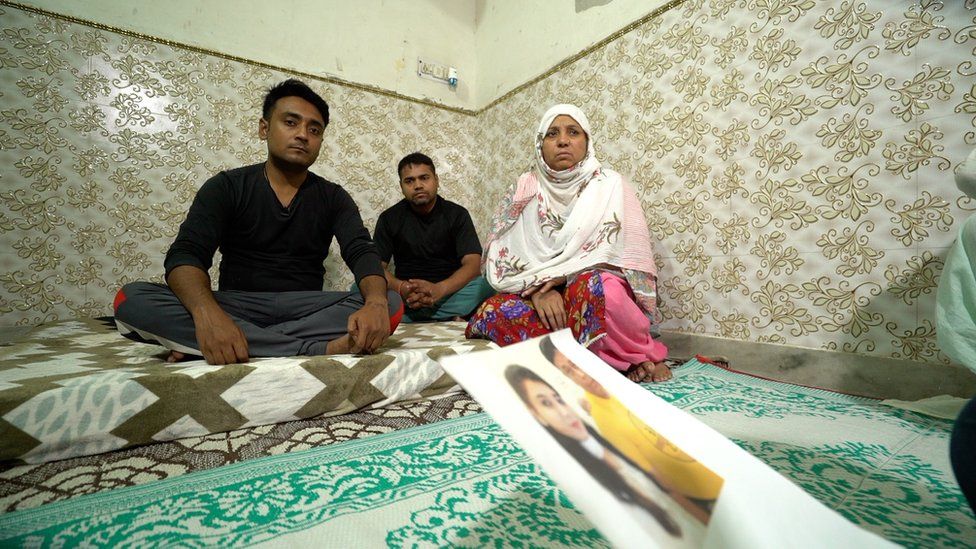
Muskan (in photo in the foreground) was among 21 people who died in a fire in Delhi
Image caption,
Muskan (in photo in the foreground) was among 21 people who died in a factory fire in Delhi in May

"This is a factory of deaths."

Ismail Khan's hand trembles as he points towards the second floor of a burnt building in India's capital, Delhi.

That was where he last saw his younger sister - trapped and suffocating, desperate to find a way out as the building was consumed by smoke and fire.

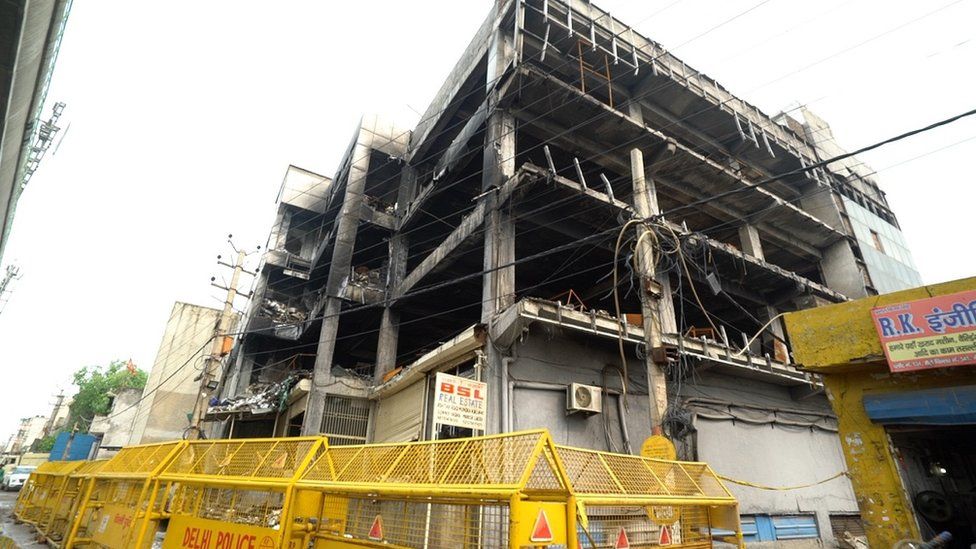
Muskan, 21, was among 27 people killed in the massive fire, which broke out in May at an electronics manufacturing unit in the four-storey building.

In the days after the fire, a top police official told media that the building's owner had not obtained clearance certificates from the fire department and police before subletting three floors of the building to two brothers who ran the manufacturing unit. The Delhi police's public relations officer also told the BBC that the unit did not have the "requisite licences" for operation.

The BBC phoned the factory owners several times but did not receive an answer. The BBC also tried to contact their lawyer but he refused to share his details where we could send queries.

India is aiming to become an industrial powerhouse, with government schemes and reforms tailored to encourage investments and innovation. But tragedies like the Delhi fire are all too common, with desperate and vulnerable workers often paying the price.

The five-storey building in Mundka, Delhi where the fire accident took place
Image caption,
Twenty-seven workers died in the building fire in Delhi

Industrial accidents kill hundreds of people and permanently disable thousands every year. A federal minister told parliament in 2021 that at least 6,500 workers had died while working in factories, ports, mines and construction sites in five years. Labour activists, who have worked in the field for years, told the BBC that the figures could be higher as many incidents are not reported or recorded.

According to data collected by global workers' union IndustriAll, sectors such as manufacturing, chemicals and construction report the most fatalities in India. In 2021 alone, it said an average of seven accidents were reported every month in Indian manufacturing industries, killing more than 162 workers.

Over the years, news reports have flagged that workers in "small, unregistered factories" are often most affected by industrial accidents. The victims are usually poor workers or migrants whose families don't have the resources to fight legal battles.

The BBC has emailed questions to the labour commissioner at the Delhi Municipal Corporation and officials at the federal labour ministry, but has not received responses yet.

'I want justice'

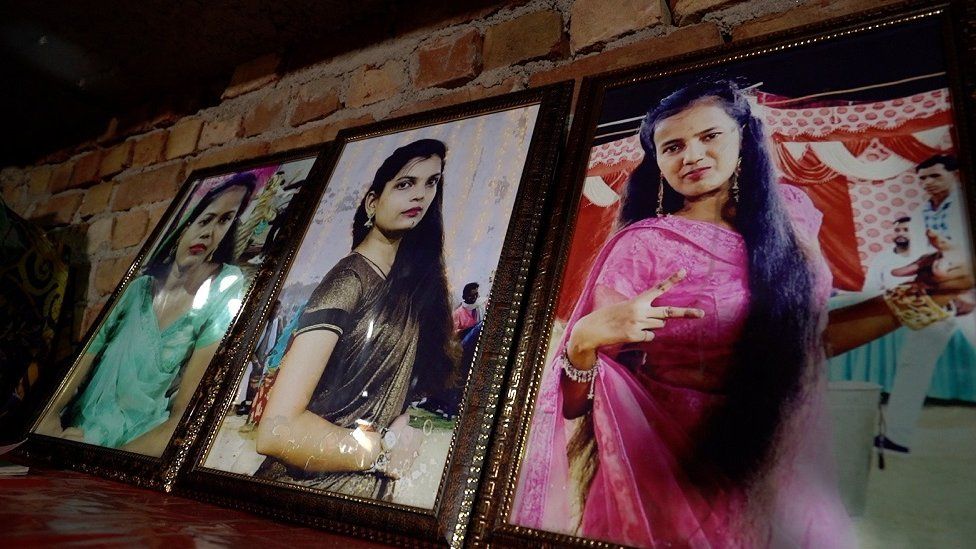
Rakesh Kumar often wakes up screaming in the middle of the night. He lost three of his daughters in the fire at the Delhi factory, where they assembled Wi-Fi routers for 8,000 rupees ($100; £84) a month each.

"My daughters must have suffered so much," he says.

Portraits of Rakesh Kumar's three daughters at his home
Image caption,
Rakesh Kumar lost three of his daughters in the Delhi factory fire

The family waited for news about them for days after the fire, until the police called them for a DNA test to identify their charred remains. His daughters were eventually cremated a month after the fire.

"I want justice for them," says Mr Kumar.

In August, the Delhi police filed charges in court against five accused in the case. They include attempt to commit culpable homicide and causing death by negligence.

Rajesh Kashyap, a trade union activist in Delhi, alleges that many factories in the capital and its suburbs flout at least one industrial or safety law, but action is rarely taken.

He and other labour activists allege that in many industrial accidents, cases languish for years while the accused are released on bail.

According to the Delhi police, 663 factory accidents were registered just in the capital over the past five years, in which 245 people died. Around 84 people were arrested in connection with these accidents.

In response to allegations from labour activists that the initial investigation in these kinds of cases is often flawed, police say they try to ensure "immediate action against the culprits". But, they add, convictions may not occur in many cases due to a number of reasons, including delay in getting forensic results and opinions from technical experts, among others.

Struggle for compensation

The BBC met several families who are still grappling with the loss of their loved ones, many of whom were the only breadwinners.

But legal red tape and a mix of factors can make it hard to access compensation from the companies.

A senior lawyer, who has worked on several worker compensation cases, told the BBC that such legal proceedings usually ran on for years.

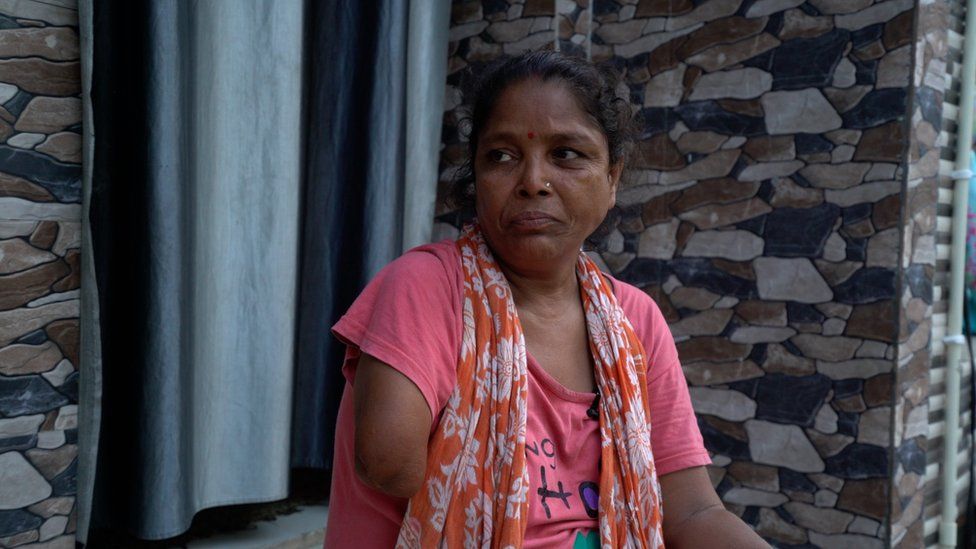
Sangeeta Roy
Image caption,
Sangeeta Roy lost her arm in a workplace accident three years ago

Often, the government itself announces a lump-sum payment to the families, shifting focus away from demanding compensation from companies.

And by the time a case is taken up, the families of the migrant workers - hurt and broken by their loss - may have moved back to their village or another city in search of jobs.

"Workers don't have much faith in the legal system due to the long, complex processes. So, they take whatever money they get as settlement or ex-gratia from the government and leave," says Chandan Kumar, who is part of a civil society organisation that assists informal workers.

The BBC tried to contact families of the victims of a 2018 factory fire in Delhi in which 17 workers died, but almost all of them had left the city.

The case is similar for those maimed by these accidents.

Sangeeta Roy, 50, lost an arm while using a cardboard-cutting machine at her company three years ago. She says she didn't receive any compensation from her employers and had to wait for three years to get a government pension for injured workers.

There is no official national data on workers left disabled by industrial accidents. But a recent survey by non-profit Safe in India Foundation - done mainly in the vehicle parts manufacturing factories in northern India - says 3,955 serious accidents took place between 2016 and 2022. Seventy-percent of the injured had lost their fingers or crushed their hands while using a metal pressing machine.

India is a major auto manufacturing hub in South Asia, employing an estimated 10 million workers. A large part of the manufacturing is contracted and subcontracted to smaller companies.

The non-profit's founder, Sandeep Sachdeva, told the BBC that many states don't accurately report such cases.

Worries for the future

India has begun reforming its labour laws through four new labour codes that include provisions for occupational safety, health and working conditions.

But activists are concerned that the new laws might set the compliance bar even lower.

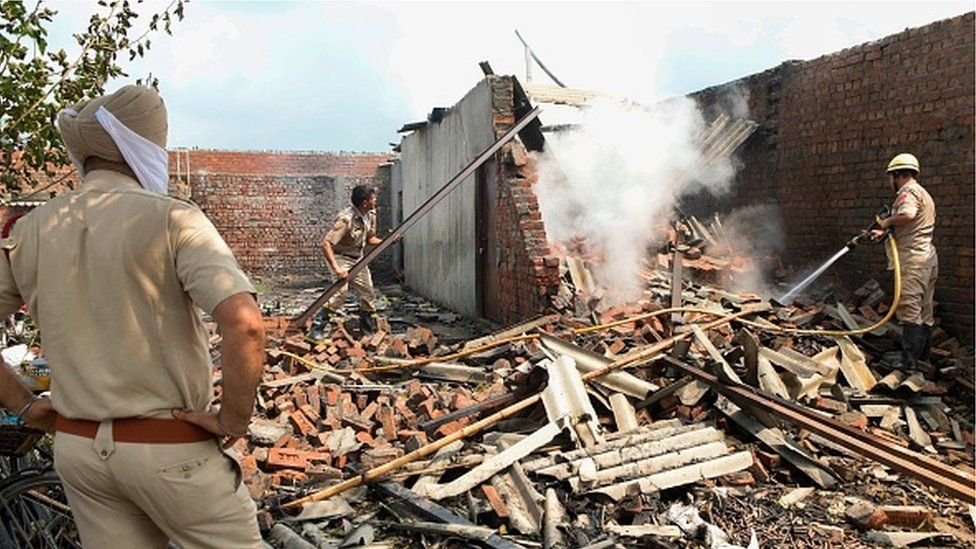
A police officer looks on while fireman douses a fire after an explosion at a cracker factory on the outskirts of Amritsar on August 2020Image source, Getty Images
Image caption,
Victims of industrial accidents often find it hard to access compensation

While the earlier law said that any company with 10 workers or more should have a safety committee, the proposed new law raises the number to 250.

But according to the 2016 Economic Census, just 1.66% of total non-agricultural establishments, 2% in manufacturing and 1.25% in the construction industry employed 10 or more workers.

There is no data available for the informal economy, which employs 90% of India's workforce.

Many companies are also shifting to hiring contract workers over permanent ones which further weakens workers' rights, says lawyer and labour rights activist Sudha Bhardwaj.

Desperation for jobs has also made workers hesitant to join unions.

The government has also changed protocols for workplace inspections in an effort to make the process easier for companies. While currently, labour officers are responsible for inspecting and ensuring the implementation of safety rules, their role will change to that of mediators under the new codes.

Labour experts say this makes it even less likely for factory owners to prioritise workers' safety or social security.

"Workers' safety will eventually be nobody's responsibility," says Sidheshwar Prasad Shukla, an academic and labour activist.

Presentational grey line


Thursday, June 9, 2022

India: Increasing incidents of Industrial Accidents, Dilution of environmnetal protections | Jagdish Patel (Sabrang India, 9 June 2022)

New Normal: Increasing incidents of Industrial Accidents, Fire, Blasts & workplace disasters

Dilution of all environmental protection regulations, assiduously fought for coupled with an utter lack of transparency makes Indian workers completely vulnerable, Gujarat leads the way


On June 2, 2022 there was blast followed by fire in Deepak Nitrite in Nandesari area in Vadodara district, Gujarat. The very next day there was a blast and fire in Valiate Organic in Sarigam industrial area in Valsad.

The Director Industrial Safety and Health (DISH) previously known as the Factory Inspectorate has been made defunct in terms of the number of inspectors employed, powers to the inspectors and their training. Clearly these developments have taken place as a result of the political will of the Government.

Why do we see an increase in industrial accidents? There will be and may be specific causes behind each incident. But broadly, these are the result of a conducive social environment created by the people in power.

The powers that be want more FDI and to attract investment on one hand they convince the investor that there will be no inspectors at your doors either to ask for a bribe or for monitoring labour law implementation. They want to jump the credit for ease of doing business rank in competition with other countries. Policies are framed to suit the industry. Inspectors are now not allowed to visit any factory at their will. Instead, industry itself is inspector by way of introducing self-certification scheme. So, now there is no Inspector Raj.

No, they don’t stop there. They are assured, there will be no prosecution in case of an accident. Our judiciary is burdened. So it helps both. The Government of Gujarat(GOG) has a very unique policy. Following a fatal accident if the employer pays ex-gratia compensation to the victim, they are assured of no prosecution and if any cases have been filed, these will be withdrawn. The Comptroller Editor General (CAG) has criticised this policy in its report.

Even when they prosecute, they are careful. They see to it that the prosecutions are filed under the sections which would draw the minimum fine. Post-Bhopal when the Factory Act was amended, Sec.96-A was inserted. This section expressly outlines a penalty for the contravention of the provisions of sections 41B, 41C and 41H of the Act. 

In their recent reports, year after year, submitted to the DGSAFLI (Ministry of Labor, Central Government), the GOG, states that they have not filed any prosecutions under Sec.96-A. The report also provides data according to which the Government loose the cases in 80% of the prosecution filed! Government pleader and the accused both are happy with the result. What fails is justice – justice to the accident victims and justice to society. 

In short there is no fear of law and poor governance which has together created a conducive social environment for accidents. This is how they do it. 

Though the primary objective of any Government is to ensure the rule of law and protection of all citizens without discrimination, through the enforcement of existing laws. Over the last several years, powerful vested interests among industry owners have ensured that the Government cease undertaking it fundamental constitutional duty. We have a law in force called the Contract Labour (Monitoring and Abolition) Act 1972. Contract workers cannot be employed for perennial activities. However, there is no will on part of Government to enforce the law and as a result we see that the number of contract workers outnumber the permanent workers. Inexperienced contract workers handle hazardous plants putting everyone’s safety at stake. 

When there are no permanent workers there are no unions. Neither industry nor Government want strong unions. Post-new economic policy Trade Unions have been weakened as part of political will and policy. So the workers have lost whatever little control they had over their plants. 

The lack of regular shut downs for routine maintenance, the unnecessary haste in restarting plants after maintenance, not following SOPs during shut down are some of the most common causes behind accidents.  Out sourcing of crucial work to the contractors further aggravates in absence of robust monitoring mechanism.  

Post-accident investigation is done by the specialised agency called DISH. They prepare reports submitted to the department which are kept concealed from the people. These reports are not available in the public domain. When you ask for reports you may be given a much diluted version of the reports. So, the documentation is poor, there is a lack technical expertise and even that weak report is kept hidden.

The Industries and Department Industrial Health & Safety Department operate with an absence of transparency. Neither the Factories Act nor the Environment Protection Act are implemented in letter and spirit and criminal prosecution provisions are not used against the top officials of the industries. Neither is there a serious follow up after the incidents. There is a need to review and evaluate all such incidences every five years to understand the reasons and systemic action based on that as a matter of the system.

Just condemning the disasters and demanding the compensation will not solve the problem nor stop further industrial disasters.

(The author is a health and safety expert)   

The views expressed in the articles of this column are those of the author and do not necessarily reflect those of the SabrangIndia

Sunday, June 5, 2022

India: Mundka factory fire and the deplorable working conditions for women workers | Anumeha Yadav and Arya Thomas

Mundka fire: The deplorable working conditions for women

  • This incident and the daily life struggle of millions of working-class women testify that no government has any agenda for dignified employment and well-being for women

On May 13, 27 workers, including 21 women, were killed in a blaze that swept through an illegal factory in the Mundka area of Delhi. While most news stories termed it a disaster, the deaths of so many female workers show the asymmetries in the working conditions for women. The deaths also show that while the thrust of policies has been to get women into the workforce, there is an absence of discussion on the terms women are compelled to accept when they join it. 

[ . . . ]

https://www.hindustantimes.com/opinion/mundka-fire-the-deplorable-working-conditions-for-women-101654260870782.html

Tuesday, May 17, 2022

India: 'No One Cares' - Naseem Ansari Is Still Waiting for His Wife, Missing After Mundka Fire

 The Wire, May 17, 2022

 Naseem Ansari

"What will Rs 10 lakh do? Where will my children go? Will my children get a parent back?"

On May 13, last Friday, a fire broke out in a four-storey building in Mundka, Delhi. Though it was on paper a residential building, and lacked a factory license and a no-objection certificate from the fire department, on three of its four floors, more than a hundred workers were employed by the lessor Cofe Impex Private Limited, a logistics firm, to assemble and pack electronic equipments such as CCTV cameras, WiFi routers and circuit adapters.

On one of the worst industrial accidents in the national capital, 27 are confirmed dead, of whom 21 were women workers, reported the Indian Express, and of the 29 who remained missing till Monday, 24 are women.

At the accident site in Mundka, Naseem Ansari, a 33-year-old migrant worker from Gorakhpur in Uttar Pradesh, continued to search for his wife Asiya, who had taken a job for the first time assembling CCTV cameras at the factory just six months earlier. Ansari recounted that Asiya had sought employment to support their two daughters’ school education in the pandemic after her husband lost two fingers on his left hand in an industrial injury in a different factory also in Mundka. Till Monday, at least 19 bodies at hospitals in Delhi remained unidentified, charred beyond recognition in the devastating fire.

Below is Naseem’s first-person account of their lives and the last few days, as told to Anumeha Yadav.

§

My name is Naseem Ansari. I operate a power press in a factory making parts for automobiles, such as steering wheels. On Friday, I was at work in the factory when one of my co-workers told me a building has caught fire in a residential area nearby. But when I finished work at 7 pm and reached the area, I saw the building my wife worked in was on fire. I did not know what to do. I looked around, listened to the onlookers who were talking, I asked them and tried to find out what is going on. But it was impossible to get any correct news on what had happened to those inside. Asiya was not allowed to keep her mobile on her while she was inside the factory.

A day after the fire, fire brigade staff at the site clearing out the area and debris. Photo: Anumeha Yadav

I am 33 years old, and Asiya was a year or so younger to me. I came to Delhi 15 years ago, in 2007, from Gorakhpur to look for work. Asiya and I had got married in 2009. Her village Pola, near Paradi Bazaar, is in Deoria, near my village in Gorakhpur. Both our fathers work as mistris in the construction sector. We have two small children, daughters who are eight and 10 years old.

Asiya studied till class VIII, and she had started working in the factory around six months ago. There were three floors. The top floor was the biggest, there could even be up to a hundred workers on the top floor sometimes, and the floors below held fewer workers. The upper or third floor was where workers assembled final parts of routers and adapters, and on the lower floor was work on CCTV cameras. There was a checking department which packed and scanned the products digitally; in the middle floor was a store and office. Asiya worked in the packing department.

At the entrance to the factory, near the staircase, workers’ mobile phones were kept. I don’t know why the company did this, but the supervisor, Pandey ji, used to instruct workers to leave their mobile phones out.

This was the first time Asiya had started going outside the home to work. On a Friday last year, I lost the top of my index and middle fingers of my left hand in a hydraulic press machine accident in the factory I worked in earlier. That company, also here in Mundka in west Delhi, manufactured television satellite dishes for major companies such as Tata and Airtel. The employer paid for my medical treatment at Jeevan Jyoti, a private hospital, but they gave me no compensation at all for the loss of my fingers and the loss of my livelihood for nearly a year after the injury.

When I first arrived in Delhi too, I had worked briefly in a power press in Mundka. Then I worked in a medical store for two to three years. But the employer retrenched me, saying we cannot afford so many workers. Then I worked in the shoe line, though that did not pay even Rs 7,000 per month. Then I joined this factory, Cofe Impex. They would make us work up and down the three floors, and the pay was only Rs 7,500, with which it was difficult to support three family members. I left and again joined a power press, where I lost two fingers in the crush accident last year.

Ansari lost two of his fingers partially in a crush injury in a hydraulic press while working in a factory that manufactured TV dish equipment last year and was denied compensation by his employer while he was laid off during his recovery. Photo: Anumeha Yadav

That company where I had got the crush injury has since shut down, it has disappeared. Many other workers too lost their fingers in that hydraulic press. But I believe because of the force of bad-dua, my curses for what they did to my hand, today that company has shut down. There is a lock on it and it had to be sold for peanuts.

We pay Rs 2,500 monthly rent, and we had to pay for our daughters’ education which was all online in the pandemic. We needed the money. We knew about this factory, because before Asiya, I had worked in this same factory for four months two years ago, physically loading the packed CCTV and “hi-fi” (Wifi) routers.

The owners of the firm had pasted a bill on a wall saying “Helpers needed”. So I went and worked there. They hire on a temporary basis, they stick bills asking for workers when needed during more production. When I worked at this factory which now caught fire, the firm paid Rs 6,000 a month to women workers and Rs 7,500 to male workers. The shift ran from 10 am to 7 pm and they gave a weekly off. If women went in, they often assigned them in packing and assembling, and if it was a male worker, then they were often assigned loading work.

I worked for less than four months doing this loading work for the firm because they paid only Rs 7,500, which is not much. I looked for other jobs and went to work in the power press machine, even though it is risky work and can cause injuries, because it pays more, around Rs 11,000 a month.

Here too at Cofe Impex Private Limited, the work was not easy, assembling and packing 1,000 pieces or more a day, running up and down the floors. But here the work shift was 10 am to 7 pm. The shift runs in a way that allows one also to look after one’s home. As the work began at 10 am, it was suitable for many women workers. A person looking after their household and family can reach the factory for duty at 10 am after finishing the house work, feeding everyone, getting their children ready and sending them to school.

This is why many women like my wife worked here, even when they paid only Rs 6,000-6,500 till two months back [this is 2.5 times less than Delhi’s minimum wage for industrial workers, between Rs 16,064/month (Rs 618/day) and Rs 17,693/a month (Rs 681/day)]. Many young women came to work here from Peeragarhi, Ranikheda, Bakarwale, from so many places. Some men worked along with them too.

I have photos of Asiya on a smartphone I had bought while online classes were going on in the pandemic. I bought one mobile for both of them and it no longer works, it is in for repair. With two children and one parent in paid work, how would that work? I do not have even an ID or a photograph of Asiya on me right now as police took whatever I brought here from me, for identification.

Hundreds of pieces of wifi equipment of the brand Oxigen and broken CCTV camera in the charred remains on the ground around the premises leased by the firm Cofe Impex Private Limited. Photo: Anumeha Yadav

The night of the fire, I returned the site at midnight after feeding some packed poori-sabzi to my daughters. When I reached the site again, someone told me (chief minister) Arvind Kejriwal had visited the site and left. Then more VIPs reached, Aazad Singh (former mayor and a leader of the Bharatiya Janta Party), the brother of former Delhi chief minister Sahib Singh Verma, I begged at his feet too. I am trying to ask whoever visits this factory site as well. I am begging them, the district magistrate and other officials when they visit, but they are all preoccupied.

After switching on the cooler for my daughters to sleep and leaving them with in my neighbours’ care, I spent the whole night at the site waiting for some information about Asiya. I wish I could find out something about Asiya, just any bit of information about where she is, if she is alright.

I went to all three hospitals [where the injured were taken] – Sanjay Gandhi Hospital, then Sonia Hospital, another hospital in Son Park – but I could get no information. I fainted and fell here in the afternoon heat waiting outside the building today. I am trying to take care of my daughters, so that they stay well. I don’t want them to feel any shock or distress. For now, I have told them your mother is in the hospital. I want to protect my children from panic and tension. Main bhi apni himmat nahi tod raha hoon [I am trying very hard to not break my own resolve right now].

The Delhi government has announced it will compensate us with Rs 10 lakh if our family member has died. What will 10 lakh do? Where will my children go? Will my children get a parent back? Will they get love? They are looking for their mother. Where should they look for their mother? They have not told us anything about Asiya yet. For how long should I keep sitting here, searching for her?

Both my daughters were born after a cesarean section surgery, we spent a lot of money on the operations – Rs 1.5 lakh on each. I spent all my life’s earning on these surgeries so that my wife and my children stayed safe.

We spend Rs 2,500 on rent monthly. We have no house of our own. No one listens to us, no one cares. The government gives to those who already have houses and property, not to the poor. First we heard “Yogi Baba”, now we are told “Bulldozer Baba”, they are demolishing homes they call illegal. When they cannot give anyone anything, why are they taking away our existing homes?

When Modi ji won the Lok Sabha seat from Varanasi, what did he say? He asked, why do you migrate from Uttar Pradesh to Ahmedabad, Mumbai? Why do children from UP’s villages go to work in the city? He said, “’Tumhare gaon mein hum chalwayenge, har ek factory basayenge.’ Kya basa diya? Aaj basa diyaa na. Sab mar gaya. Duniya mar gaya. Bache marey. Sab marey. Kya cheez basaye hain? [‘I will ensure and nurture commercial enterprises in your villages, in every village in Uttar Pradesh, there will be a factory.’ What did he nurture? Today we have seen what they created. Minors have died. So many have died. It is like the world is coming to an end. What have they (the powerful) created?]”

As told to Anumeha Yadav.