Tuesday, March 5, 2024
Wednesday, November 15, 2023
Bangladesh garment workers fighting for pay face brutal violence and threats | Thaslima Begum and Redwan Ahmedin (Nov 15, 2023)
The Guardian
Bangladesh garment workers fighting for pay face brutal violence and threats
Workers describe hands and arms being targeted in ‘merciless’ beatings as protests over low wages turn increasingly violent in Dhaka
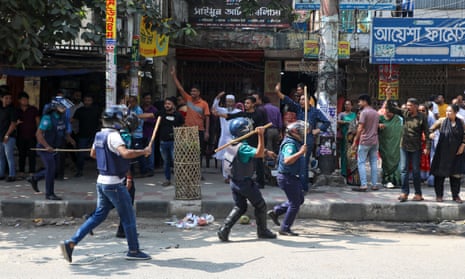
Garment workers clash with police in Dhaka on 2 November during protests over low wages in Bangladesh. Photograph: Kazi Salahuddin Razu/NurPhoto/Shutterstock
When Masuma Akhtar arrived at the garment factory where she works on the outskirts of Dhaka on 31 October, she was expecting a normal shift. Instead, she was met with brute violence. “The moment I walked through the factory gates, a group of armed men began beating me with wooden sticks,” says Akhtar. “I fell down on to the ground. Even then they wouldn’t stop beating me.”
Akhtar, 22, is a seamstress at Dekko Knitwears in Mirpur, where she spends long days churning out clothes for western fashion brands, including Marks & Spencer, C&A and PVH Corp, which owns Tommy Hilfiger and Calvin Klein.
Bangladesh is one of the world’s biggest producers of fast fashion, pumping out millions of tonnes of clothing every year to meet the demands of the world’s most popular clothing brands, which are drawn to this small South Asian country where orders – and the labour needed to fulfil them – come cheap.
Although most fast fashion brands that source from Bangladesh claim to support a living wage, they are only required to pay the workers who make their clothes the legal monthly minimum wage, which is one of the lowest in the world and has remained set at 8,000 taka (££58) since 2018.
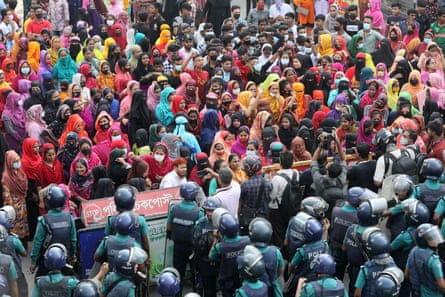
Negotiations over a new minimum wage for garment workers in Bangladesh have sparked mass demonstrations on streets across the capital. The protests have escalated since the government announced a minimum wage increase for the workers, from 1 December, to 12,500 taka (£90), far below the 23,000 taka a month workers say they need to keep their families from starvation.
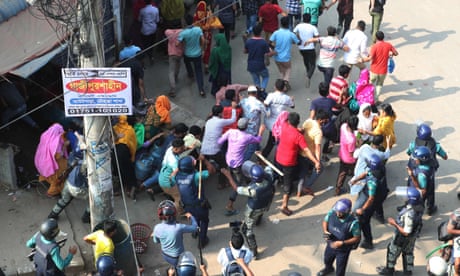
Factory owners and police have responded to workers’ protests with threats and violence. The beatings she received by armed men at Dekko Knitwears left Akhtar with a broken arm. “They hit my back, my thighs and my arms repeatedly,” she says. Now, without use of one of her arms, she is unable to work. “I don’t know how I will survive the rest of the month,” she adds.
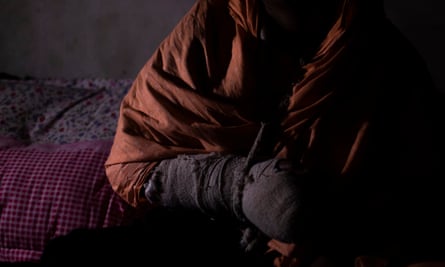
Other workers at Dekko Knitwears say that the men beating them concentrated on their hands and arms. “They started hitting us mercilessly,” says Bushra Begum, 25, another worker. “My livelihood depends on my hands, and they targeted them viciously.”
Her colleague Rita Anwar, 26, tried to run away but was chased down the road by three men. “I am covered in blood clots,” she says, pulling up her sleeve to reveal her injuries. “My back is black with bruises. The pain is so much that I can barely walk.”
Before they left, the men issued a warning: the workers were not to take part in any more protests – or they would face consequences.
As protests in Dhaka turned increasingly violent, two garment workers have been killed, allegedly after being shot by police in the first wave of protests. And last Wednesday, another woman died after being shot in the head.
Factory owners also threatened to shut down production and withhold wages by applying a “no work, no pay” rule. Over the weekend, more than 150 factories closed “indefinitely”, as police issued blanket charges for 18,000 workers in connection with the demonstrations.
Workers were warned of dismissal if they continued to protest and the Bangladesh Garment Manufacturers and Exporters Association, a trade body, called for all factory recruitment to be paused, making it difficult for protesters to find work elsewhere.
But despite the violent crackdown on workers, those who have spoken to the Guardian are determined to see the fight through to the end.
“They are trying to silence us but we won’t back down,” says Naima Islam, a machine operator at Columbia Garments. “They can threaten and beat us but what they don’t understand is, we have nothing to lose. If we accept their ridiculous wage proposal, we will starve to death anyway.”
Islam, 28, is one of thousands of protesters who have had police reports filed against them, which trade unionists fear may soon lead to mass arrests. Many believe it is an attempt to forcefully suppress the wage increase movement.
But that hasn’t deterred Islam and her co-workers. “We are not asking for much. This entire industry is built off our backs – the least we deserve is the bare minimum to survive,” she says.
Nazma Akter, president of local trade union Sommilito Garments Sramik Federation, condemns the violence against protesting workers. “The Bangladesh government must ensure workers are able to exercise their rights to freedom of association and collective bargaining without fear of violence, reprisal, or intimidation,” she says.
In a statement, Marks & Spencer said: “These are very serious allegations and we are urgently investigating them. We would never tolerate violence or intimidation of workers and set out very clearly in our global sourcing principles that workers must be guaranteed freedom of association and a safe workplace, as well as fair and transparent wages. As a member of the Ethical Trading Initiative, we have supported the tripartite minimum wage negotiations between the unions, Government Wages Board and the Employers’ Association – and we continue to support cross-sector calls for an increase that provides a decent standard of living for workers.”
A spokesperson for C&A said: “We are aware of the incident that took place in Bangladesh, and we are in close contact with the supplier to investigate. We condemn all types of violence, and we have a longstanding commitment to ensure the safety and health of all workers in our supply chain.”
PVH did not respond to a request for comment.
Dekko Knitwears and Columbia Garments were approached for comment but did not respond.
Fashion brands sourcing from Bangladesh have said they support workers’ calls for a higher minimum wage. In a joint letter in September, brands including Asos, Primark and H&M, wrote that they recognised their role in “supporting wage developments”. But rights groups argue that this means little if brands don’t agree to pay their suppliers more.
Yesterday, Human Rights Watch and Clean Clothes Campaign called on brands to take responsibility for their workers’ wages and pay their suppliers more. Aruna Kashyap, associate director on corporate accountability at Human Rights Watch says: “Wage increases have consequences for suppliers’ costs and eat into their profit margins.”
“Brands themselves are driving low wages with their unfair pricing and purchasing practices,” she adds. “To preserve their own profits, brands are putting themselves first.”

Wednesday, April 26, 2023
On Ten Years After the World’s Deadliest Garment Factory Disaster of 2013 | Saurav Sarkar
Ten Years After the World’s Deadliest Garment Factory Disaster
In 2013, more than 1,130 garment workers were killed when the Rana Plaza building collapsed in Bangladesh. Has enough changed to keep it from happening again?
Imagine you’re sent home from work because there are cracks in the building. You’re told to come back the next day, and you do, dutifully, because you don’t have a choice; you don’t want to get fired. The owner of the building says it’s just a problem with the plaster.
But when you show up, it’s clear that the problem runs deeper. You don’t want to go back in, but your manager tells you that you’ll lose a month’s pay and your bonus if you don’t. You see another manager hit a coworker who doesn’t want to go into work.
Ten years ago, that was the choice facing garment workers and other
staff at the Rana Plaza building in Dhaka, Bangladesh. As we now know,
the building collapsed at about 9 a.m. on April 24, killing more than
1,130 people, most of whom were garment workers.
[ . . . ]
https://progressive.org/latest/ten-years-after-worlds-deadliest-factory-disaster-sarkar-230425/
Wednesday, April 1, 2020
Coronavirus threatens Indian garment workers stranded in factory housing | Anuradha Nagaraj
Coronavirus threatens Indian garment workers stranded in factory housing

By Anuradha Nagaraj
CHENNAI, India, March 30 (Thomson Reuters Foundation) - The coronavirus pandemic has left tens of thousands of Indian garment workers stranded in cramped accommodation on factory premises where social distancing is difficult to put into practice, labour rights campaigners said on Monday.
A three-week nationwide lockdown has left an estimated 300,000 workers in India's multi-billion dollar garment stuck in factory hostels where rooms are shared by up to a dozen people.
Most manufacturing units and spinning mills in the southern state of Tamil Nadu are closed - those supplying to hospitals remain open - leaving workers in close proximity and raising concerns that they could unknowingly be spreading the virus.
"Hostel conditions are not ideal at all under the circumstances," said R. Karuppusamy, director of charity Rights Education and Development Centre, which helps garment workers.
"We are very concerned for these young workers as many have been in and out of the factory before the lockdown was announced," he told the Thomson Reuters Foundation by phone.
India has at least 1,071 cases of the coronavirus and 29 have died. Officials say India is weeks away from a major surge in cases that could overwhelm its weak public health system.
About 40,000 garment factories and spinning mills operate in Tamil Nadu, with many running hostels on their premises to house their staff - most of whom are young women and migrant workers.
Social distancing is key to containing the spread of the virus in the sector, said state health secretary Beela Rajesh.
"All factories have been made aware of this," Rajesh said.
"Besides, the industries and labour department officials have set up teams to monitor and inspect factories."
The teams will ensure that factories remain closed, monitor sanitation and hygiene, and check on workers' health, she added.
SOCIAL DISTANCING CONCERNS
The Southern India Mills' Association (SIMA) - a trade body representing about 500 factories - has also instructed members to ensure all workers on their premises are given due care.
"But there are challenges and social distancing is probably the toughest," said Selvaraju Kandaswamy, its general secretary.
SIMA is urging its members to pay their workers at least half of their wages while closed. The federal government and Tamil Nadu state have instructed factories to pay salaries during the lockdown, and provide workers with food and shelter.
Temporary factory closures and layoffs have already begun to hit garment workers across Asia - from India and Bangladesh to Cambodia - with top global brands delaying or cancelling orders.
SIMA has asked the government to allow the partial reopening of factories as this would enable shift working and free up space in hostel rooms to facilitate better social distancing.
"We want to start production so that workers are not sitting idle in rooms," Kandaswamy said. "It will help in social distancing as well since rooms will not be overcrowded.
"We understand the implications of coronavirus and well-being of workers is of utmost importance."
(Reporting by Anuradha Nagaraj @AnuraNagaraj; Editing by Kieran Guilbert. Please credit the Thomson Reuters Foundation, the charitable arm of Thomson Reuters, that covers the lives of people around the world who struggle to live freely or fairly. Visit http://news.trust.org)
source URL: https://news.trust.org/item/20200330115141-jaq9i/