Showing posts with label employment. Show all posts
Showing posts with label employment. Show all posts
Monday, March 18, 2024
Monday, March 4, 2024
Saturday, February 10, 2024
India: Ten-Year Record on Employment: Does the Reality Match the Promises or Claims? | Santosh Mehrotra
The Wire
Ten-Year Record on Employment: Does the Reality Match the Promises or Claims?
GOI efforts to spin a jobs growth narrative has meant the following: it is not willing to recognise a glaring problem, and hence no concrete efforts are needed to change economic policy to make the growth pattern more labour-intensive.
07/Jan/2024
by Santosh Mehrotra
This article is part of The Wire‘s ‘India Black Boxed’ series. Read it here: Introduction | Part I
The current regime started with pretty impressive promises in 2014 with respect to employment (two core jobs a year). If realised, by March 2024, 40 crore new jobs should have materialised. Have they? If not, what is the reality?
The reversal of employment growth in non-farm sector and little progress in Skill India
The reality is the following. First, open unemployment was barely 2.1% in 2012 (the last year for which data was available before the BJP came to power). It had already nearly tripled to 6.1% in 2018 (National Survey Organization’s Periodic Labour Force Survey (PLFS), conducted annually since 2017-18), the highest rate in 45 years of India’s labour force surveys.
The total number of unemployed was one crore (2012) before the BJP came to power – but it had tripled by 2018 to three crore. The youth unemployment rates went through the roof for: those with middle school (class 8) education it rose from 4.5% to 13.7%; with secondary education (class 10) from 5.9% to 14.4%; those with higher secondary (class 12) education from 10.8% to 23.8%.
Educated unemployment worsened sharply. For graduates, the unemployment rate rose from 19.2% to 35.8%; and for post graduates from 21.3% 36.2%. All this did not deter the Government of India (GOI) from announcing a New Education Policy 2020 that higher education enrolment should rise from the prevailing 27% (for the relevant age cohort of 18-23 year olds) to nearly double to 50% by 2035. How are these new higher education graduates supposed to be employed, if the current crop of graduates face rising unemployment.
ls Report 2021 argues that nearly half of India’s graduates are unemployable, i.e. education quality in our colleges/universities has deteriorated sharply, most noticeably after the massification of higher education in the last two decades. Two developments underlie this phenomenon. First, the number of affiliated colleges (attached to universities, where the exam is conducted by the state or central university) has grown in India from around 10 000 in the early 2000s to 42 000 to 2020. The Universities (let alone the University Grants Commission) have limited capacity to regulate or monitor the activities of such colleges; yet they have grown at a rate of 4 new colleges per day, without a weekend break. Two, most of these colleges are private, set up by builders and contractors, in connivance with local politicians, who are often elected to high offices. If this pattern of private college growth, the quality is unlikely to improve, so unemployment may remain much the same – if non-farm jobs do not grow fast enough to absorb new entrants.
[ . . . ]

Saturday, September 2, 2023
India: CPM leader Brinda Karat's letter to Minister of Rural Development on MGNREGA
Brinda Karat's letter to Minister of Rural Development on MGNREGA
Date: Wednesday, August 30, 2023
Smt. Brinda Karat, member, Polit Bureau of Communist Party of India (Marxist) had written today the following letter to Shri Giriraj Singh, Minister of Rural Development, Government of India drawing his attention to the negative impact of several policy decisions taken by the government regarding MGNREGA.
We are herewith releasing the text of the letter for publication.
***
Shri Giriraj Singh ji,
Namaskar. I write this letter to you to draw your attention to the negative impact of several policy decisions taken by the government regarding MGNREGA. As one who was actively involved in the finalisation of the Act and the clauses regarding the rights of workers, it is a matter of deep concern that workers’ rights for demand based work are being compromised. The fund allocation is woefully inadequate. According to the data on the Ministry’s website 91 per cent of funds allocated have been already spent. At present average workdays are at a low of just 35.4 days. In such a situation MGNREGA workers will face acute problems. Moreover, mandatory stipulations such as online registration of attendance at worksites as well as Aadhaar based payments are converting unconditional rights embedded in the law into restricted access for job card holders.
Introduction of Aadhaar linked payments of wages has not resulted in much change in timely payment of wages. In June, the government in a press release from PIB had assured that the Ministry was not insisting on Aadhaar enabled system of payment but on Aadhaar based payment system (ABPS) which would be more flexible. However, a most revealing survey conducted by an organisation reported in The Hindu, August 30, 2023, shows that out of the “total 26 crore job holders, 41.1 per cent are still not eligible for this mode of payment. From five states with the largest number of active job holders, 1.2 crore workers will not be eligible for payments as they do not have ABPS accounts”. The survey also shows on the basis of an analysis of data recorded in the central data base of the government that there is statistically very little difference between ABPS and normal account transactions as far as the amount of time taken for payments are concerned or as far as percentage of rejections are concerned. In other words, while so far there is no significant benefit, there is certainly evidence of significant losses for workers.
In the last six months I have visited MGNREGA sites and interacted with workers across states. A common complaint has been the introduction of the attendance system through online registrations at the worksite at specific times during the day. Given that the connectivity is very poor in vast areas of rural India, particularly in remote tribal areas, mandatory online registration is leading to great difficulties for the workers. Women workers who comprise the majority of MGNREGA workers in many States, have been particularly affected. As you know, women workers are charged in our patriarchal cultures for the main responsibility of domestic work and care of families. Before and after their MGNREGA workday women put in many more hours of work. However, they complain that because of the lack of connectivity, sometimes they have to spend one hour extra getting their attendance registered. There are also examples of attendance not getting registered leading to denial of wages.
In my interaction with women workers, I found that the SORs and the piece rates decided are extremely difficult to complete. In the current situation as far as women’s work norms are concerned MNREGA sites are illustrations of the extraction of female labour at low rates to create public assets. There has been no Ministry initiated recent time use surveys on MNREGA sites. Earlier in many states, work norms for women were decided after such surveys. This is an urgent requirement.
I hope you will consider the issues I have raised and take appropriate action.
Thanking you,
Sd/-
Brinda Karat
Monday, May 29, 2023
India: Too few jobs, too many workers and ‘no plan B’ | Tara Subramaniam and Sania Farooqui (CNN)
Too few jobs, too many workers and ‘no plan B’: The time bomb hidden in India’s ‘economic miracle’

India gains global new title as China's population declines
02:34
- Source:
CNN
New Delhi
CNN
—
Sunil Kumar knows all about working hard to achieve a dream. The 28-year-old from India’s Haryana state already has two degrees – a bachelor’s and a master’s – and is working on a third, all with a view to landing a well-paid job in one of the world’s fastest growing economies.
“I studied so that I can be successful in life,” he said. “When you work hard, you should be able to get a job.”
Kumar does now have a job, but it’s not the one he studied for – and definitely not the one he dreamed about.
He has spent the past five years sweeping the floors of a school in his village, a full-time job he supplements with a less lucrative side hustle tutoring younger students. All told, he makes about $85 a month.
It’s not much, he concedes, especially as he needs to support two aging parents and a sister, but it is all he has. Ideally, he says, he’d work as a teacher and put his degrees to use. Instead, “I have to do manual labor just to be able to feed myself.”
Kumar’s situation is not unusual, but a predicament faced by millions of other young Indians. Youth unemployment in the country is climbing sharply, a development that risks undermining the new darling of the world economy at the very moment it was expected to really take off.
Advertisement
India’s newfound status as the world’s most populous nation had prompted hopes of a youthful new engine for the global economy just as China’s population begins to dwindle and age. Unlike China’s, India’s working age population is young, growing, and projected to hit a billion over the next decade – a vast pool of labor and consumption that one Biden administration official has called an “economic miracle.”
But for young Indians like Kumar, there’s a flip side to this so-called miracle: too few jobs and too much competition.

From ‘miracle’ to disillusion
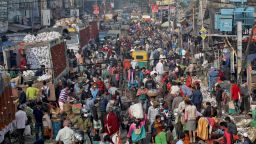
In contrast to China, where economists fear there won’t be enough workers to support the growing number of elderly, in India the concern is there aren’t enough jobs to support the growing number of workers.
While people under the age of 25 account for more than 40% of India’s population, almost half of them – 45.8% – were unemployed as of December 2022, according to the Centre for Monitoring Indian Economy (CMIE), an independent think tank headquartered in Mumbai, which publishes job data more regularly than the Indian government.
Some analysts have described the situation to CNN as a “time bomb”, warning of the potential for social unrest unless more employment can be created.
Kumar, like others in his position, knows all too well the frustrations that can build when work is scarce.
“I get very angry that I don’t have a successful job despite my qualifications and education,” he said. “I blame the government for this. It should give work to its people.”
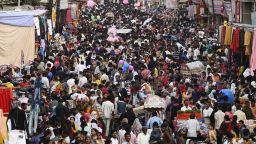
The bad news for people like Kumar, and the Indian government, is that experts warn the problem will only get worse as the population grows and competition for jobs gets even tougher.
Kaushik Basu, an economics professor at Cornell University and former chief economic adviser for the Indian government, described India’s youth unemployment rate as “shockingly high.”
It’s been “climbing slowly for a long time, say for about 15 years it’s been on a slow climb but over the past seven, eight years it’s been a sharp climb,” he said.
“If that category of people do not find enough employment,” Basu added, “then what was meant to be an opportunity, the bulge in that demographic dividend, could become a huge challenge and problem for India.”
‘There’s competition everywhere’
To be clear, it’s not all doom and gloom.
Economists say India has various options to address these demographic problems – among them, developing an already globally competitive and labor-intensive manufacturing sector, which accounted for less than 15% of employment in 2021, according to Capital Economics, a relatively low amount.
But such fixes on the macro level will do little to help those who are struggling now. Students like high-schooler Megha Kumari, who must take ever more extreme measures to get an edge on the competition.
Kumari, 17, has left her hometown of Dumka, in the eastern state of Jharkhand, to study at the Vibrant Academy in Kota, a city in the northern state of Rajasthan – more than 800 miles (1,300 kilometers) away.
The academy is one of several such centers across India where students hoping to qualify for top-tier colleges go to augment the regular high school curriculum with extra exam prep courses and tutoring sessions.
Kumari sees it as her best chance of realizing her dream of becoming a professor, but it comes at great cost, financially and personally.
In a country where the average salary for regular full-time workers is around $225 per month, according to the most recent government figures, tuition fees for one year at the academy range from around $145 to $1,872.
Kumari said she also keenly misses the support her family used to provide.
“The environment is actually really competitive,” Kumari said. “Living alone and away from family and going through all that stress is hard for a student.”
Her situation, too, is not unusual.
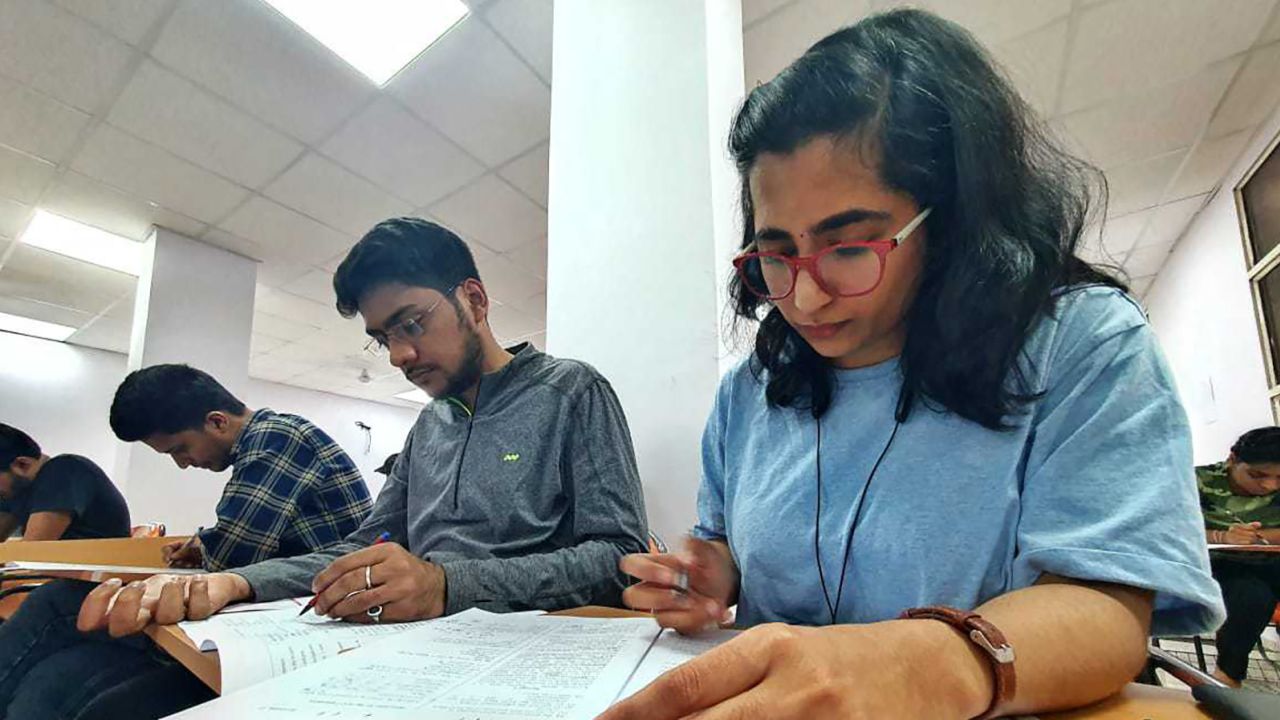
“Since childhood, we’ve been facing this competition,” said Sarang Agrawal, 28, who is studying for the Indian civil service entrance test.
“In India, there’s competition in every exam. There’s competition everywhere.”
No social life, no love life … and no plan B
Like Kumar and Kumari, Agrawal knows all about competition. He is among the more than 1 million people who apply each year for a position in the Indian civil service.
It’s one of the country’s most highly sought-after jobs and, with less than 1% of applicants making the cut, a whole industry has grown up around helping people get their hands on what they see as a golden ticket.
“As the population has increased, the competition has increased, so people’s chances have reduced,” said Madhusudan, who goes by only one name and is the director of content and strategy at Study IQ, a tuition center specializing in helping people study for the civil service entrance exam.
India’s youth, he says, are feeling the pressure.
“You can see the stress level is very high these days among the students. Students come to me and say ‘Sir, I’m not able to sleep,’” Madhusudan said.
There’s precious little time for anything to defuse the tension – “No social life, no love life,” as Agrawal put it, “but at least we have a goal.”
Still, in this most competitive of markets, even the most driven are tested to their limits.
Agrawal has taken the civil service exam four times without success. Continuing with his dream is costing his family dearly, to the tune of around $3,000 a year when tuition fees, food and housing are taken into account.
“They could have bought three to four cars with the money they spent on me,” said Agrawal, who feels he has no other option but to keep trying.
“There’s no such Plan B,” he said.
Wednesday, March 15, 2023
India: The naukri question: Despite headline good news on jobs, there are worrying trends: more farm workers & women in self-employment
Editorial
March 15, 2023
The naukri question: Despite headline good news on jobs, there are worrying trends: more farm workers & women in self-employment
GoI recently issued its annual Periodic Labour Force Survey (PLFS) 2021-22, the most comprehensive government dataset on employment. Juxtapose the 2021-22 dataset with PLFS 2018-19, the last pre-pandemic annual report, and one important change emerges. The number of Indians in the labour force increased from 37.5% of the population to 41.3% in 2021-22 on the back of a big jump in women entering the job market. However, parse the data and the trends that emerge are not so happy.
Two features stand out. One, the employment structure is regressing as more people are shifting back to agriculture where productivity and wages are lower. Two, the rise in women’s participation in the labour force is coming through self-employment and not jobs in factories or the service sector. Let’s start with the employment structure as it represents the big picture of the economy. In 2018-19, agriculture’s share of jobs was 42.5%. By 2021-22, it had increased to 45.5%. This is alarming for two reasons. Moving a greater proportion of the workforce out of agriculture to industry and services is essential for India’s economic transformation. This process picked up pace in the early part of the 21st century. If the reversal persists, realising India’s demographic dividend will be tough.
The shift towards agriculture has come at the cost of the already low level of employment in manufacturing. In 2018-19, 12.1% of jobs were in manufacturing. By 2021-22, it had dipped to 11.6%. Within this overall structure of employment, the nature of additional jobs being created points to a serious challenge. For India’s workforce, most additional jobs are coming in the self-employed category. This is pronounced for women. Consequently, the percentage of jobs in both the salaried and casual labour categories has declined. It’s not just that the openings that women have is tilted towards the self-employed category. A big chunk is as a helper in household enterprises, which PLFS reports point out excludes regular wages for work. It means many of the new jobs don’t translate into steady purchasing power. This is among India’s most serious economic challenges.
Thursday, August 11, 2022
Global Employment Trends for Youth 2022 | ILO
The ILO report is available here Global Employment Trends for Youth 2022: Investing in transforming futures for young people
Subscribe to:
Posts (Atom)