This a continuation of the Labour Notes South Asia (LNSA) dispatches | We also hope to build a partial archive of posts from the original LNSA mailing list (2000 to 2019) (see list URL) | See archived posts 2004-2005 | [the full webarchive of the list is now unavailable as it has been permanently removed by yahoo on Dec 2019]
Some relief: Editorial on West Bengal government’s initiative for wage labourers
The initiative will be supervised by the West Bengal Migrant Workers’ Welfare Board and will offer financial assistance to the families of migrant workers in case of a tragedy
The Editorial Board
The crises faced by India’s migrants were brought to the foreground by the Covid-19 pandemic. But the plight of this constituency is much older. Wage labourers migrate to cities in search of better employment opportunities, greater remuneration, and frequent work. But they have to put up with poor — often inhuman — living conditions, the lack of social securities and weak bargaining rights. This powerlessness of migrant labourers makes the West Bengal government’s intervention offering a host of amenities worth examining. The initiative, dubbed first of its kind in the country, will be supervised by the recently-constituted West Bengal Migrant Workers’ Welfare Board and will offer financial assistance to the families of migrant workers in case of a tragedy. Regional offices would reportedly be opened in Maharashtra, Delhi and Kerala — the hubs where migrants travel to for work from Bengal — along with round-the-clock assistance centres. The scheme also seeks to introduce a portal for migrant workers to register their names. This is an important step in enumerating migrant workers and is in line with the Centre’s long-term plan — a plan that has not materialised beyond the rudimentary e-Shram portal — to create a national database for migrants. But the initiative is quite likely to face several challenges. Bengal — not quite the richest of states — must make sure that adequate funds are available for the proper implementation of this programme. Moreover, Bengal’s workers under the Mahatma Gandhi National Rural Employment Guarantee Act are yet to receive their dues from the Centre on account of alleged irregularities. This delay is likely to increase the rate of migration from Bengal to other states. So the welfare scheme for migrant labourers should be prepared for an additional burden of beneficiaries. The persistent plight of migrant workers is, however, indicative of a larger problem — the State’s shift in focus away from the stipulations of social welfarism. This worrying trend has been echoed by the prime minister, Narendra Modi, who has derided welfare schemes intended to benefit the poor as ‘rewadis’. What compounds the problem is the uneven economic development of states: the largest proportion of migrants hails from poorer states like Uttar Pradesh, Bihar and West Bengal. Equitable, inclusive development, yet another pledge of the prime minister, remains elusive, lengthening the march of migrants.
‘We give our blood so they live comfortably’: Sri Lanka’s tea pickers say they go hungry and live in squalor
Top
tea firms investigate as plantation workers say they have to pick 18kg a
day but still skip meals and make their children work
Global development is supported by
Jeevan Ravindran in Maskeliya
Tue 23 May 2023 06.00 BSTLast modified on Tue 23 May 2023 17.36 BST
Some
of the world’s leading tea manufacturers, including Tetley and Lipton,
are examining working conditions on the plantations of its Sri Lankan
suppliers, following a Guardian investigation.
Two
global trade-certification schemes, Fairtrade and the Rainforest
Alliance, are also conducting inquiries after it was revealed that some
workers on 10 certified estates could not afford to eat and were living
in squalid conditions.
Tea pickers claim that estate owners failed to support them during the country’s unprecedented economic crisis,
which has seen prices of food, fuel and medicine soar, without wages
rising to match. The pickers reported supervisors refusing to pay them
what they were owed and incidences of verbal abuse.
Some
of the pickers said they had so little money that they were having to
skip meals and felt forced to send their children to work.
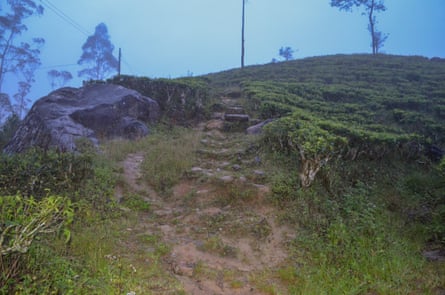
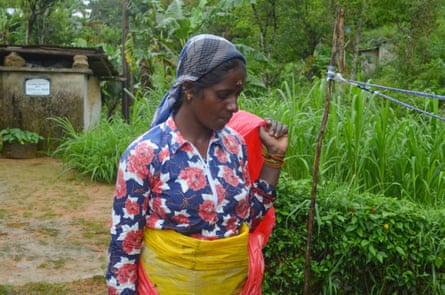
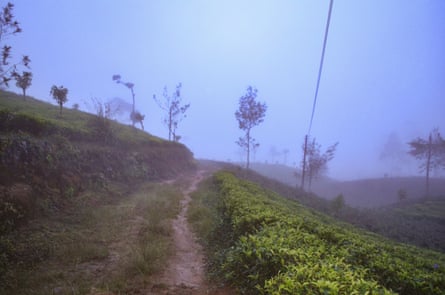
Rangasamy Puwaneshkanthy, a plantation picker, lives in these hills above a tea estate. She has taken out loans to pay for food
Tetley
said it had suspended work with some central Sri Lankan estates while
it conducted its own inquiries. Ekaterra, which owns Lipton and PG Tips,
said it was in contact with the Rainforest Alliance over the findings.
Yorkshire Tea, another company that sources tea from the estates the Guardian visited, said it was speaking to the plantations concerned.
More than 300,000 people work in Sri Lanka’s tea plantations, which are mainly in the mountainous Central Highlands. In 2022, the industry generated £1.079bn in exports.
Tea pickers have been struggling since the country was plunged into an economic crisis after a disastrous ban on chemical fertilisers
in 2021, which decimated tea yields and caused production to fall to a
26-year low last year. Workers must pick at least 18kg (40lb) a day to
earn 1,000 Sri Lankan rupees (about £2.60/$3.25) – a fee set by the
government’s wage board in 2021. If they pick less, they get a lower
rate for each kilo.
The depreciation of the
rupee has caused the average daily wage in the sector to fall in real
terms over the 24 months to February 2023 from £3.90 to £2.20. A bailout
from the International Monetary Fund in March saw the figure bounce
back slightly to about £2.60. But inflation, which hit an all-time high of 86% in September, has kept food prices high.
Lakshman Devanayagie, a tea picker, said her treatment by estate supervisors had affected her mental health
In January, the UN World Food Programme estimated that 44% of families in tea estate areas were food insecure – twice the figure of urban districts.
Workers
claimed some estate supervisors have tried to underpay workers.
Lakshman Devanayagie, 33, said: “Even if we pick good tea leaves, they
will say it’s not good enough, and they will tip it out, or that they
are going to cut our pay.
“If we give them five
kilos of tea leaves, they will only pay us for two or three. When we
ask them, they say, ‘we’re doing as we’re told, so why don’t you do as
you’re told?’,” she said, adding that she felt suicidal at times.
Rangasamy
Puwaneshkanthy lives with her husband and three children in the hills
above one tea estate. She said has had to take out loans to pay for food
and regularly missed meals, adding that she often chose to forgo buying
sanitary towels so she could buy food for her children.
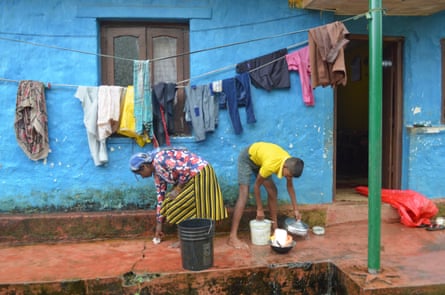
Lakshman Devanayagie and her son at their home. Many workers live in tiny homes with no running water or toilets
“If
there’s no food at home, then I don’t take any to work. I tell them
[supervisors] I’m going home for a bit and then come back, because I
can’t watch other people eating,” Puwaneshkanthy said.
She
said pressure to pick quickly meant that she did not have time to watch
out for leeches, which are common in the damp climate. Last year, her
leg became infected from one and she had to walk for an hour to see a
doctor because she could not afford a rickshaw ride.
“If we stop to pick the leech off, then we’ll be one kilo down – that’s how we’re thinking when we work,” said Puwaneshkanthy.
“We don’t know what to do. We’re working on the estate, but we have no salary. What are we meant to do?”
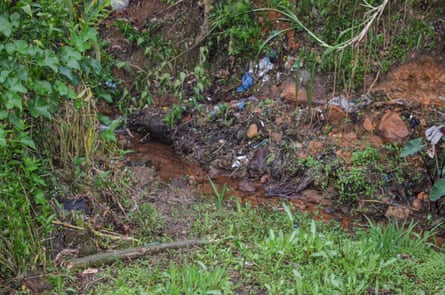
Tea pickers speak of woeful living conditions that leave them having to defecate in nearby rivers
Another
worker, Subramaniam Sathyavani, 40, said she felt dehumanised working
on the estate. “We give our blood so the managers can live comfortably,”
she said.
The tea estates are run by companies
that lease land from the government. Most workers are Malayaga Tamils,
descendants of indentured labourers brought from southern India by
British colonisers. Most still live in the tiny homes built by the
British, which are now owned by the plantations.
Some
have no running water or toilets, and workers say they are forced to
defecate in nearby rivers. Puwaneshkanthy’s eldest son says sometimes he
doesn’t go to the toilet because he’s too scared of the snakes and
leeches in the water. One woman said her husband had died after drinking
contaminated water.
While
they are not forced to stay on the plantations, there are few other job
options in the area for the tea pickers, and many have limited
education.
Picker Rangasamy Puwaneshkanthy, second right, with her three children in the accommodation they share with her husband.
The
rural location means workers have little choice but to use amenities
provided by the estate, such as childcare, the costs of which are
deducted from their wages. The Guardian has seen a number of wage slips
that showed monthly deductions of 50% or more.
At
least once last year, Puwaneshkanthy said, she was left with nothing at
the end of the month after all her bills had been deducted.
“If
we work 22 or 23 days, because of all the cuts we only get about 15, 16
days’ worth of pay. And then when they cut everything… they give us,
there’ll be no salary left,” said Puwaneshkanthy, who in January left
the estate to work 75 miles away as a housemaid in Colombo, where she
can earn more money.
Jeevan Thondaman, Sri
Lanka’s minister for water and estate infrastructure, said the findings
showed “exploitation in its finest form”.
He
said: “We have to find a way to expedite or accelerate this process of
giving them decent work. And I have a feeling we can do that by
involving international agencies [like the] UN, Flocert [a trade
certification body] and Fairtrade.”
A
tea plantation in the Central Highlands. Fairtrade is one of several
organisations investigating working practices at the sites
Thondaman
said some plantations had lied and had “bullshitted” to all these
foreign organisations that they were “ethical” to get funding. He wants
the government to break up the estates and lease land to workers to grow
their own cash crops, giving them greater control.Fairtrade,
which certified three of the plantations visited, said it had referred
the Guardian’s allegations to its independent certifier, Flocert, and
the Fairtrade protection committee, which oversees the safety of
children and vulnerable adults.
In a statement,
it said plantations were obliged by the Fairtrade Standard for Hired
Labour Organisations to adjust wages to keep pace with inflation.
“Fairtrade
takes allegations of worker mistreatment very seriously. Indeed,
improving the livelihoods of workers in challenging regions is one of
the reasons that Fairtrade was established,” it said.
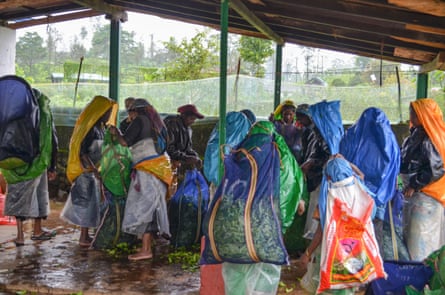
Workers at a tea plantation weighing site; pickers must pick at least 18kg a day to earn 1,000 rupees (£2.60)
The Rainforest Alliance, which has certified nine estates, said it was “deeply concerned by the allegations”.
“We
take this matter very seriously and will be conducting our own
investigations, as is our usual process,” said Madhuri Nanda, the
alliance’s south Asia director. “These investigations will inform next
steps and appropriate action, which could include suspension or
cancellation of the certificates of the tea estates in question.”
Lalith
Obeyesekere, secretary general of the Planters’ Association of Ceylon,
the body that represents the plantation companies that the Guardian
visited, said claims that salary deductions left workers with no wages
were “unsubstantiated”. Any deductions had to be authorised and not
exceed 50% of a worker’s wage. He said employees could file grievances
if they believed too much money had been deducted but no complaints had
been reported by members.
Obeyesekere said
plantation workers got 14 days of paid holiday and 14 days’ sick leave a
year, as well as bonuses, three months’ paid maternity leave, and free
maternal and childcare until the child was five. Workers were also
entitled to allowances of milk powder, flour and rice, and the children
received free medicine and vaccinations.
He said investments were being made to improveamenities, including
housing, sanitation and hygiene facilities. He added that the industry
was exploring all possible options to mitigate the worst effects of the
economic crisis for employees and that increasing wages was a top
priority for the association. However, its members could only pay
employees out of revenues and was calling for an end to the current
payment system.
In August, Sri Lanka’s court of appeal dismissed a petition by plantation owners seeking to reverse the 2021 wage increase.
Thondaman
said he would lobby the wage board to increase pay. He also said new
technology, such as digital weighing machines, which have already been
installed on a few estates, should be rolled out more widely.
However,
Palani Digambaram, an MP from the National Union of Workers, who grew
up on tea estates, said people were working as “slaves, without proper
food or salaries”.
“If there are no tea
plantations, I’ll be happy. Do our people only have to work on tea
plantations?” he said. “With leeches and snakes biting them, tigers and
this and that coming, just having to pluck tea leaves, what will their
life be like? Those women are suffering.”
Pakistan lags most countries in
the application of labor law and in following the ILO's standards. The
dismal state of labor law enforcement is the reason Pakistan ranks 8th
out of 167 countries in the Global Slavery Index.
About 3.3 million Pakistani children are trapped in child
labor, depriving them of their childhood, health, and education, and
condemning them to a life of poverty and want. It has been estimated
that almost a quarter of women aged 20-49 were married before the age of
15, and 31% before they reached eighteen years of age. Only 34% of
children under five are registered at birth nationally (PDHS). Birth registration is a fundamental right
of all children as legal proof of a child’s existence and identity. As
an accurate record of age, it can help prevent child labor and child
marriage, and protect children from being treated as adults by the
justice system.
Pakistan, like other parts of the world, is celebrating Labor Day to
honor workers’ contributions for the country’s development and
prosperity. Pakistan has ratified the 36 International Labor
Organizations (ILO) conventions, as well as the fundamental conventions.
Being a signatory of the ILO conventions, Pakistan is responsible for
honoring international standards related to fundamental principles and
rights at work.
One in every four households in Pakistan employs a child in domestic work, predominantly girls, between 10 to 14 years of age.
The International Labor Organization Declaration on Fundamental Principles and Rights at Work
was adopted in 1998 and amended in 2022 required all members to uphold
basic human values that are vital to our social and economic lives. It
further requires that the government, employers, and workers’
organizations should affirm the obligations and commitment that are
inherent in membership of the ILO and require that they should protect
and uphold the freedom of association and the effective recognition of
the right to collective bargaining, work towards the elimination of all
forms of forced or compulsory labor, and put in place measures that
guarantee the effective abolition of child labor. The elimination of
discrimination in respect of employment and occupation, and the
provision of a safe and healthy working environment are also
requirements set by the ILO.
However, in the case of Pakistan, though we have ratified
international labor conventions and signed various declarations on
fundamental principles at work, we have not yet implemented those in
letter and spirit in our country. On World Day Against Child Labor (WDACL) in 2022,
the ILO highlighted that one in every four households in Pakistan
employs a child in domestic work, predominantly girls, between 10 to 14
years of age. UNICEF
estimated that 3.3 million children were trapped in child labor, which
deprived them of fundamental rights such as education. Though there are
several laws discouraging child labor in Pakistan, children continue to
employed to perform domestic work. The U.S. State Department in a report
also raised concerns about child labor in Pakistan, and quoted that the
Child Protection and Welfare Bureau rescued over 1,000 children from
begging in Punjab and referred 1,500 to 2,000 children for psychological
counseling.
The report
highlights that about 9.8% of Pakistan’s population is children between
10-14. There is a higher proportion of children working in Sindh than
in Punjab, with agriculture, domestic labor and the industrial sector
being the most common employers of children. The ratio of children
attending school is 77.1% in Punjab, but only 60.6% in Sindh.
Moreover, the International Labor Organization released a report
in 2023 from a committee of experts on the application of conventions,
with serious concerns about Pakistan related to the Right of Association
(Agriculture) Convention, 1921, and stated that share of the employed
labor force in the agriculture sector in Pakistan is around 67.24
million which stands at 37.4% of the total employed workforce. Despite
that, there is no specific legislation available to protect agricultural
worker’s rights. The report further states that all the Federal and
Provincial Industrial Relations Acts are applicable to formal sectors,
but not to the agriculture sector.
The report further highlights that there are no restrictions on
agriculture sector employees to form a union. The report states that
Balochistan Industrial Relations Act, 2022 (hereafter BIRA 2022)
provides in its section 1(4) that the Act shall apply to all workers and
employers at all workplaces working or conducting business within
Balochistan. It further points out that the Government of Sindh has
registered four unions of agriculture workers and two associations of
landlords of agriculture farms. However, the workers engaged in
agriculture holdings that do not run an establishment or farmers working
on their own, or with family are out of the ambit of industrial
relation laws. The committee urged Pakistan to ensure that federal and
provincial Industrial Relations Acts are amended to expressly cover all
agricultural workers, including those in the informal sector, and to
enable them to enjoy the rights conferred by the Convention in law and
in practice. It requests the Government to provide information on any
progress achieved in this respect.
Apart from the agriculture sector, the report
highlighted concerns regarding the formation of associations for
workers as well as managerial staff, and urged the government to revise
all Industrial Relations Acts, federal as well as provincial, and ensure
that both labor and the managerial workers can form and join the
organization of their choice. Pakistan was also asked to amend the laws
to accommodate the workforce of Export Processing Zones (EPZ). Though
Pakistan assured that it has withdrawn S.R.O. 1004(1)/82, except clause
7, through a notification dated 5 August 2022, and stated that the eight
industrial relation laws which are not applicable to the EPZ are now
applicable. The Government also informed the committee that it has
formed the rules in this regard as well, however, a copy of the rules
was not provided to the committee to examine the veracity of the rules.
The committee urged the government to provide a copy of the final
version of EPZ (Employment and Service Condition) Rule 2009 and provide
them with information about the rights of trade unions in the EPZ and
their registration criteria.
Pakistan ranked 8th out of 167 countries on the modern slavery index
Apart from improving the right of association, the country is very
relaxed in implementation of labor laws. Being a member of the ILO,
Pakistan has so far failed to implement a 40 hour work week and minimum
wage rules in the private sector. Workers who are employed in the
markets or in the private sector normally work between 12-16 hours a day
for seven days, whereas people employed to serve as domestic workers
even work for longer hours, however, in reward, they do not even get the
minimum pay set by the government of Pakistan.
Consequently, these workers are forced to live a life that resembles
modern slavery. Law enforcement agencies adopting a largely lenient
approach in implementing labor laws is the main hurdle in the upliftment
of living standards of workers and eliminating poverty. The Norwegian Human Rights Fund,
referring to the report of the Global Slavery Index stated that
3,186,000 people in Pakistan are victims of modern forms of slavery, and
Pakistan ranked 8th out of 167 countries on the modern slavery index.
The government of Pakistan should realize that any further delays in
implementing labor laws not only tarnishes the country’s image on global
platforms, but also increases unemployment in the country.
Ten Years After the World’s Deadliest Garment Factory Disaster
In 2013, more than 1,130
garment workers were killed when the Rana Plaza building collapsed in
Bangladesh. Has enough changed to keep it from happening again?
Imagine you’re sent home from work because there are
cracks in the building. You’re told to come back the next day, and you
do, dutifully, because you don’t have a choice; you don’t want to get
fired. The owner of the building says it’s just a problem with the
plaster.
But when you show up, it’s clear that the problem runs deeper. You
don’t want to go back in, but your manager tells you that you’ll lose a
month’s pay and your bonus if you don’t. You see another manager hit a coworker who doesn’t want to go into work.
Ten years ago, that was the choice facing garment workers and other
staff at the Rana Plaza building in Dhaka, Bangladesh. As we now know,
the building collapsed at about 9 a.m. on April 24, killing more than
1,130 people, most of whom were garment workers.