Showing posts with label domestic labour. Show all posts

Sunday, July 9, 2023

India: Sofa to lift, RWA curbs on service staff smack of deep-rooted bias | Rohan Banerjee


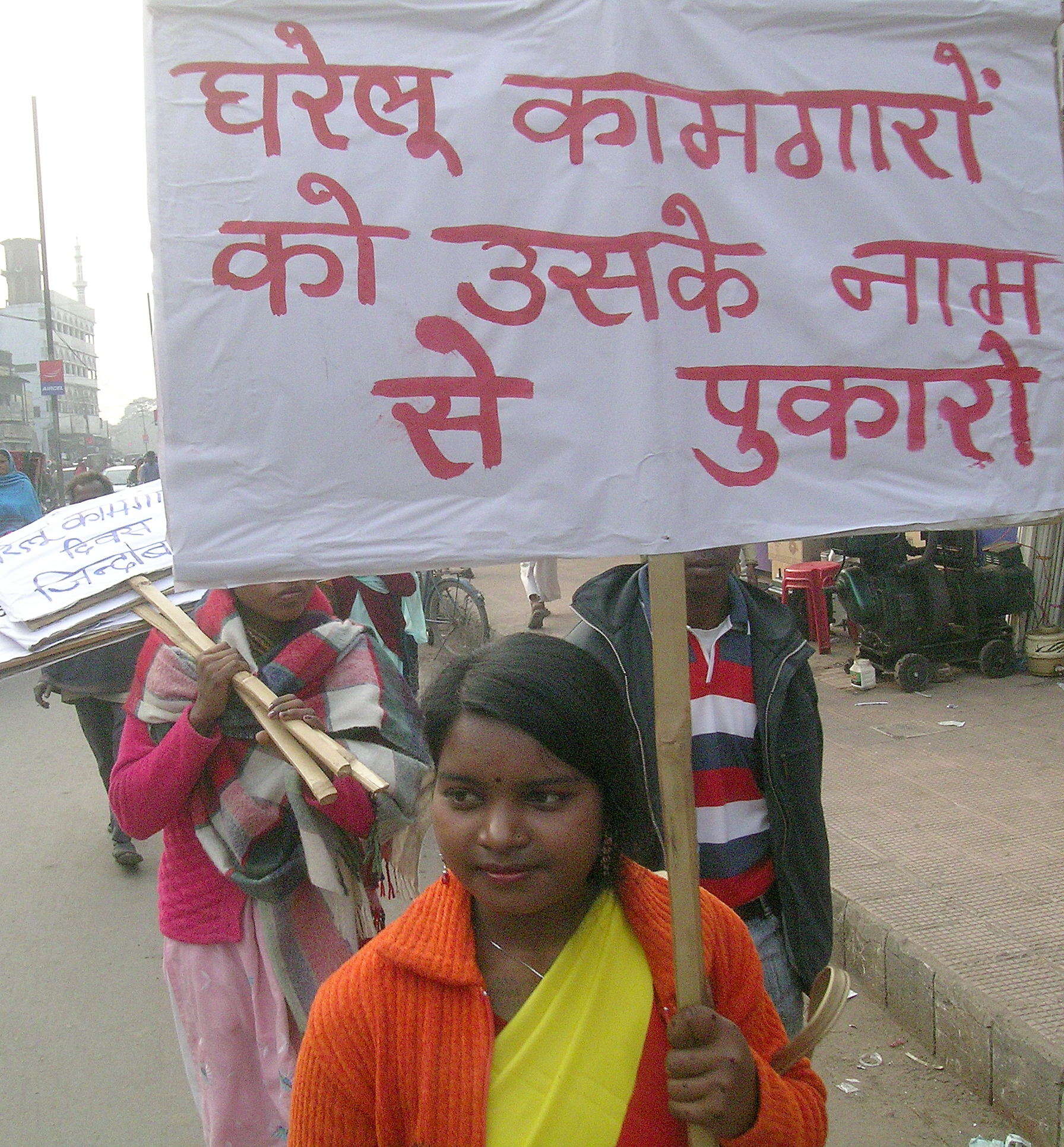
Domestic workers took out a rally on the occasion of International Domestic Worker Day in Patna on Friday. pic by–k m sharma


The Times of India

Sofa to lift, RWA curbs on service staff smack of deep-rooted bias

July 8, 2023, 9:14 PM IST

Rohan Banerjee is a Mumbai-based lawyer

A few days ago, a Twitter post about a proposal made to the Residents’ Welfare Association (RWA) of a housing society in Bengaluru made headlines. The proposal noted how residents “can feel uncomfortable when being surrounded by maids” in the common area and also decried the use of sofas at the building reception by “cooks, carpenters, plumbers”. “Most of us,” it blithely stated, “have probably stopped sitting on the sofas by now.” A Twitter user would later point out that the post was by a ‘single individual’ and not an RWA notice, but this clarification doesn’t change the fact that such instances of deep-rooted bias are on the rise in affluent residential societies.

The ‘service lift’ is now a common feature in most high-rises, and the building security is quick to draw the lakshman rekha for drivers, delivery persons and domestic help using it. Indeed, discriminatory practices, such as restricting access to parks, gazebos, etc are so rampant as to have become the norm in urban gated societies.

In a bid for legitimacy, these prejudicial rules are often justified on the grounds of ‘security’ or ‘convenience’. The widespread paranoia in the early days of the Covid-19 pandemic, for instance, had brought out the classism of RWAs which imposed various directives on domestic staff on the pretext of hygiene and sanitisation. Ironically, at the time, it was the staff that was more at risk of being infected by their globe-trotting employers.

These persistent attempts to police the movement of domestic workers within housing societies stem from an urge to erase any jarring reminders of inequality in our utopian islands of prosperity. This urge is physically manifested in the high compound walls that surround our apartment blocks — stark on the outside but aesthetically trellised with exotic plants within — which serve to hide the adjoining slums from our sight. In a country where the top 10% households own 65% of the total wealth (according to the World Inequality Report 2022), owning (or even renting) a home in these luxury estates is a privilege only a few can afford. Having gained entry, we rely on the walls — and the rules and bye-laws of our RWAs — to preserve exclusivity.

The paradox lies in the fact that we cannot afford to make this exclusivity absolute because the people we do not want ‘loitering’ in our gardens are the very people we rely on to keep our homes clean, cook our food, walk our dogs, drive our cars, and retain order in our lives. And so, we make grudging concessions to allow access while constantly regulating the spaces they can inhabit and even the economic value we ascribe to their services. Evidence of the latter can be found in the ‘rate cards’ for household work that are circulated on RWA WhatsApp groups to ensure so-called transparency for employers. The truth of the matter is that these employers are likely to spend more on a single meal in a fine-dining restaurant than the prescribed salary their help can earn in a month. A recent report about a study by the Indian Institute of Human Settlements noted that “domestic workers in Bengaluru and Chennai would have to work in six low-paying households to earn the state minimum wage”.

Every time reports about discrimination against domestic workers surface, we express our outrage and then quieten down — until the next incident. Perhaps it is time we began to examine the role we can play in breaking this cycle. There is little institutional support available to domestic workers, as the legal framework governing the informal domestic work sector is practically non-existent. Domestic workers fall outside the purview of the traditionally understood scope of ‘workmen’ under labour laws and only a handful of states cover them under the Minimum Wages Act. Also, the National Policy for Domestic Workers envisaged in 2019 to include them under existing laws is yet to be implemented. In this environment, the biased actions of RWAs add to their woes.

A few years ago, the apartment complex I lived in considered introducing a rule mandating that staff members should only access elevators from the basement parking lot; what was left unsaid was that their presence in the swanky glass-and-marble lobby irked certain residents. Thankfully, most of the other residents immediately shot down this suggestion and the idea was dropped. In the Bengaluru RWA incident as well, a Twitter user stated that more than 20 people had “pushed back” on the proposal to restrict common area access. If this were indeed the case, it is heartening.
It is convenient to ignore prejudices that do not affect us, if simply to avoid conflict with the housing society overlords. But this indifference comes at a cost. It is only by protesting against unjust diktats, that we can stop them from perpetuating their problematic worldview and perhaps, even change RWAs to being an agency for good.


Thursday, June 15, 2023

Invitation to mark “International Domestic Workers Day” on 16 June 2023 in Bengaluru | Karnataka Gruha Karmikara Vedike (KGKV)


KARNATAKA GRUHA KARMIKARA VEDIKE

affiliated to

NATIONAL PLATFORM FOR DOMESTIC WORKERS


Invitation to Women’s Organisations, progressive movements, Activists, Academics, Advocates, Friends, Students, Domestic Workers organisations and Workers Unions to participate and extend solidarity on the INTERNATIONAL DOMESTIC WORKERS DAY on 16th June 2023 between 11:30 a.m. to 3:00 p.m  at the Freedom Park, Bengaluru.


*********************


Karnataka Gruha Karmikara Vedike (KGKV) is a Platform of all the Unions and Organizations who are working with Domestic Workers in Karnataka. KGKV is affiliated to National Platform for Domestic Workers, New Delhi, and it is commemorating “International Domestic Workers Day” all over the country on 16th June 2023.


On 16th June 2011, the International Labour Conference of the International Labour Organization adopted a Convention concerning Domestic workers, which is also referred as “Decent Work for Domestic Workers - Convention-189 which offers specific protection to domestic workers all over the world.  It lays down basic rights and principles, and requires State to take a series of measures with a view to making decent work a reality for domestic workers. 12 years have passed but the Union Government of India has not yet ratified this convention.

Therefore the National Platform for Domestic Workers and its affiliated organisations from all the States have resolved to continue to fight and pressurizing the Governments in addressing and ameliorating the precarious conditions of domestic workers.  Several Hundred’s of women workers and worker leaders would join in the Public Meeting at Freedom Park, and demand the Government of India ratify ILO C-189 and the State Assembly passing a resolution to this effect.

On the 16th of June 2023 the Unions, Civil Society Organisations and concerned public in Bengaluru  urge the Government of Karnataka to declare, that this Day should be considered as a “Domestic Workers Day” and declare this day as a Holiday in Karnataka, in recognizing specifically womens economic contribution since the paid Domestic work is one of the supporting pillars of today’s market economy and it is inherently tied to the process of informalisation. 

Domestic workers leaders from Bangalore will articulate their issues and demands.  Leaders from various progressive movements, Feminist leaders, Central Trade Unions Leaders will address.  We have invited The Chief Minister and several other leaders from the State Government to address the workers and receive our Memorandum and pressurize them to evolve appropriate action in ameliorating the precarious conditions of Domestic workers in Karnataka.

Kindly we invite you to come to this programme and give a message of solidarity from your respective organisations pressurizing the Union Government in order to ratify ILO Convention C-189 as well other demands.

Thanking you in Anticipation.


Dr.RUTH MANORAMA                    BRINDA ADIGE                                     KEMA DEVI

State Convenor, KGKV               Co-Convenor, KGKV                             President, KGKV

Thursday, June 8, 2023

India’s Domestic Workers: Key Issues Remain Swept Aside | Neetha N.


Latest from The Hindu Centre
Issue Brief No. 14
India’s Domestic Workers: Key Issues Remain Swept Aside
NEETHA N.

They may have been elevated, in terms of politically correct vocabulary, from ‘servants’ to ‘maids’, and now as ‘domestic workers’. However, despite high-sounding intentions and some hesitant calls for progress, much remains to be done to improve the lot of this neglected and vulnerable workforce. Accurate numbers, an acceptable legal definition, protection by state enforcement agencies, and other such key ingredients for effective policy making remain elusive for this workforce, which has been chronically afflicted by official apathy.

In this Issue Brief,
Neetha N., Professor, Centre for Women’s Development Studies, New Delhi, contextualises the reasons behind the continued neglect of India’s domestic workers. She draws attention to the socio-economic equations that result in an asymmetric balance of forces in this unique relationship between employer and employee, where the workplace is the former’s home and the latter’s workspace.

This imbalance is further aggravated by a form of patron-client relationship in employment, where other factors, such as caste, gender, vulnerability, internal work hierarchies, and weak or non-existent and unenforceable contractual obligations, are embedded. Consequently, the indispensable role played by domestic workers in the smooth functioning of many a household is matched by a persistent devaluation of the very nature of the job. Mere laws and policies, she emphasises, will remain statements of intent — and further evidence of state neglect — unless they draw from stakeholder consultations and lessons gained from the ground. 
Read More...

Monday, July 11, 2022

India: Placement agencies for care-domestic labour | Shalini Grover (Modern Asian Studies, 2022)


Placement agencies for care-domestic labour: Everyday mediation, regimes of punishment, civilizing missions, and training in globalized India

Published online by Cambridge University Press:  21 February 2022

Abstract

Survey data on Indian labour points to a rapid expansion of the care-domestic economy, currently the main employment avenue for urban women. Hitherto, studies on domestic service portray the unequal class structures of master–servant relationships and the escalating phenomenon of live-out and part-time hired help. This article shifts the focus to under-researched, yet increasingly visible, placement agencies, which regulate care-domestic markets and provide diverse services, from specialized ‘patient care’ to the training of subaltern communities. The article discusses how these service providers denote prominent shifts in skill sets, intra-household care arrangements, forms of medical assistance, and new (and old) mechanisms of authority. The ethnography expands our knowledge of everyday mediations around hiring and training between agencies, employers, and care-domestic workers in New Delhi. The article puts forward innovative conceptualizations of service provider approaches through juxtaposing the informal practices of local (or Indian) agencies with formalized and ‘civilizing’ agendas developed by Euro-American intermediaries. The formal–informal dichotomized framework of service provider relationships adds to critical scholarship that contrived dualisms which need historical scaffolding and nuanced engagement. I argue that, while informal and formal approaches appear markedly different for the care-domestic economy, they also overlap. Significantly, both approaches are unjustly weighted against the workers who lack the potential to democratize labour relations. Local agencies reinforce exploitative care-domestic relationships, while Euro-American intermediaries, who espouse modern values, formalization, and civilizing experiments, promulgate punitive regimes and stigmatized futures for their Indian subjects.

Type
Research Article
Creative Commons
Creative Common License - CCCreative Common License - BY
This is an Open Access article, distributed under the terms of the Creative Commons Attribution licence (http://creativecommons.org/licenses/by/4.0/), which permits unrestricted re-use, distribution and reproduction, provided the original article is properly cited.
Copyright
Copyright © The Author(s), 2022. Published by Cambridge University Press

Introduction

In its simplest form, a placement agency is a service provider that employers can approach to hire care-domestic workers and through which workers may seek employment opportunities. For the management of the care-domestic economy, two approaches are conceptualized and form the subject of interrogation in this article. The first is represented by local (or Indian) agencies which retain the core characteristics of casualized, informal sector work. These local agencies offer informal care arrangements, which I call ‘pay-as-you-go’ services (my emphasis), that are symbolic of a sort of convenience, whereby users are absolved from long-term, tenured, or stable commitments.Footnote 1 The employer does not pay an advance for a specific amenity and the worker's employment remains undocumented and typically casual. Work arrangements in this model are based on oral agreements, adept mediation, and a hierarchy of labour roles. The second is a Euro-American (or expatriate) exemplar, whereby attempted formality with a civilizing mission is introduced into an otherwise informal sector. This is a purported model of modernizing labour relations that offers documentation practices and professional care-domestic work.

For most of the twentieth century, modernity has been characterized by attempts to formalize social relations.Footnote 2 Misztal outlines ideal features of formality that are reliant on official and legal roles, and structures of power.Footnote 3 Post-colonial and postsocialist societies are generally more allied with informal economies and their unofficial open secrets, tacit rules, and hidden practice.Footnote 4 In the sociological literature, following Goffman's conception of ‘role distance’, informality and formality are typically considered opposites.Footnote 5 In two recent volumes, however, scholars have challenged the formal–informal dichotomy, emphasizing overlaps and interdependence across the world.Footnote 6 These collections stress the value of informal practices as invisible yet central to human societies rather than as a disadvantaged residual of the formal economy. They also question the supposedly ‘unregulated’ nature of informal sectors,Footnote 7 while critiquing the notion that formality plays into the hands of those it is meant to defend or represent.Footnote 8 With regard to service providers and debates on the care-domestic economy in contemporary India, this article reassesses modernization claims and perceptions of formality as ‘good’ and informality as ‘bad’.Footnote 9

Indian labour markets have historically been dominated by informality.Footnote 10 Yet the studies of industrial labour by Holmström, Breman and Harriss in the 1970s–1980s were key to unlocking the rigid boundaries between formal and informal jobs.Footnote 11 From the 1990s onwards, Gooptu and Parry instrumentally portray how the formal sector is being ‘deformalized’.Footnote 12 The latter is reproducing inferior working conditions resembling those found in the precarious informal sector, while cheap contract labour has increasingly replaced the permanent workforce.Footnote 13 At the same time, especially with the informal care-domestic economy having gained visibility,Footnote 14 discussions around formalization have permeated feminist debates.Footnote 15 The exploratory nature of these conversations is whether a framework for formalization, at its lowest bar represented by a written contract, ensures better conditions for workers.Footnote 16 The formalizing of casualized labour is indeed being attempted by embassies, placement agencies, hospitals, universities, and the corporate sector. Gooptu's work is salient for its minutiae of how labour in India's private corporate sector has meant vast mobilization, recruitment, and training of workers in a highly organized manner, usually involving the state.Footnote 17 Under the neo-liberal ascendency, low-level marginalized service workers are now subjected to formal systematic training, grooming, and socialization, in a radical break from the past. Gooptu's caveat is that what is rendered as formalization is ‘performed formalization’. She underscores how formal and informal processes exist within the same labour regimes. This article contributes to the theoretical contention that formal and informal approaches have their meeting points. Significantly for the care-domestic economy, both approaches reinforce inequalities for workers who lack the potential to democratize labour relations. The practices of service providers direct us to the immediacy of colonial legacies, exploitative work relationships, punitive regimes, and how the employers’ class position remains privileged.

[ . . . ]

FULL TEXT HERE